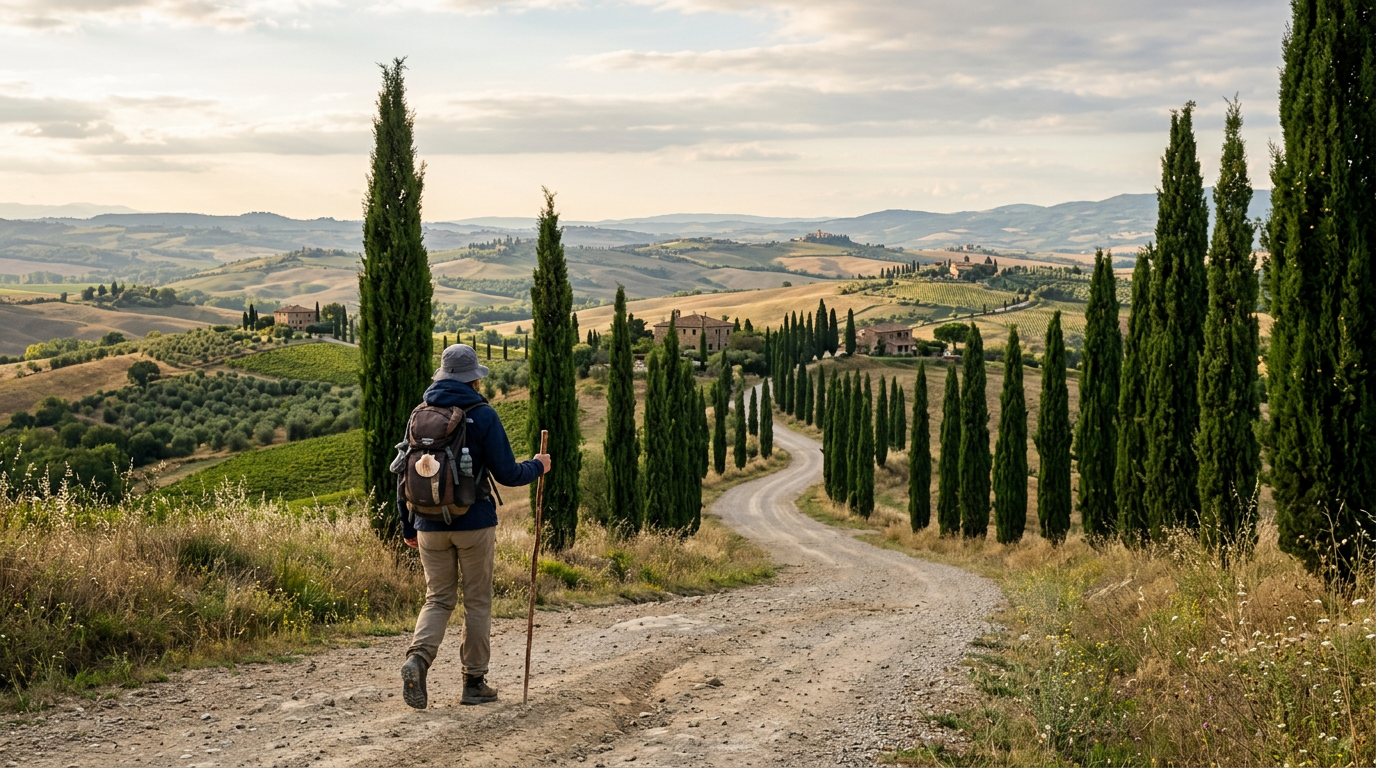
Via Francigena Tuscany: walking the stages through the Val d'Elsa
The Via Francigena is one of Europe’s oldest and longest pilgrimage roads. It runs from Canterbury in southern England to Rome, covering approximately 1,800 kilometres through France, Switzerland, and Italy. The Italian section begins at the Great St Bernard Pass in the Alps and ends at the Vatican. Within that long journey, the Tuscan stretch is widely regarded as the most beautiful.
You do not need to walk the whole route to experience it meaningfully. Many people walk just one or two stages, using the Francigena as a framework for moving slowly through a landscape that has been walked by travellers for well over a thousand years. The Val d’Elsa section, which passes near Barberino, is among the most accessible and rewarding stretches anywhere on the route.
The Via Francigena in Tuscany
The Via Francigena enters Tuscany from the north through the Lunigiana, the mountainous territory between Liguria and Tuscany. From Pontremoli it descends through the Cisa Pass toward the Garfagnana, crosses the Apennine foothills, and reaches Lucca. From Lucca the route continues south across the Arno valley and into the Chianti hills.
The historical route did not pass through Florence. The main medieval road skirted the city to the west and followed the Elsa river valley southward toward Siena. This Val d’Elsa alignment is what brings the Via Francigena through the territory around Barberino Val d’Elsa and Tavarnelle.
The Tuscan section covers roughly 380 kilometres in total, divided into approximately 15 stages of varying length and difficulty. The terrain shifts from the flat river plains of the Arno valley to the gentle hills of the Chianti, and then to the more open clay landscapes of the Crete Senesi south of Siena. The character of the landscape changes considerably from north to south, and this variety is part of what makes the Tuscan Francigena so satisfying to walk.
Navigation is aided by yellow signs bearing a stylised pilgrim figure and the Canterbury cross, posted at regular intervals throughout the route. The waymarking is generally reliable, though a printed guide or downloaded GPS track adds security on stretches where signs are less frequent.
The stages from Florence to Siena
The Florence-to-Siena section of the Via Francigena covers about 120 kilometres and divides naturally into four or five walking stages. It is the most popular multiday segment in all of Tuscany, combining cultural interest, outstanding landscape, and a range of accommodation options along the way.
The first stage from Florence passes through the southern suburbs of the city and climbs rapidly into the Chianti hills. This transition from the city to the countryside happens within a few kilometres and is one of the more satisfying moments of the whole route. By the time you reach San Casciano Val di Pesa, about 25 kilometres from the centre of Florence, you are completely in the rural world.
The second stage runs from San Casciano south through the Chianti Classico vineyard zone to Tavarnelle Val di Pesa or Barberino Val d’Elsa, a distance of about 20 to 22 kilometres. The paths here follow white gravel roads between rows of Sangiovese vines, through stands of cypress and oak, and past stone farmhouses. The elevation changes are moderate and the walking is genuinely pleasant.
The third stage connects Barberino Val d’Elsa to Colle di Val d’Elsa, a distance of about 20 kilometres. The route descends into the Elsa valley and follows the river south through a mix of agricultural land and woodland. The town of Colle di Val d’Elsa, known for its glassmaking tradition, makes a worthwhile overnight stop.
The fourth stage runs from Colle di Val d’Elsa to Monteriggioni, about 18 kilometres. The approach to Monteriggioni across open fields, with the circular crown of towers becoming progressively clearer on the horizon, is one of the most dramatic arrivals on the whole Francigena.
The fifth and final stage brings you from Monteriggioni into Siena, about 20 kilometres. The city enters the route with increasing drama as you approach through the hills and finally pass through one of the great medieval gates.
Each stage requires five to seven hours depending on fitness level, terrain, and how many stops you make. The recommended pack weight is under eight kilograms including water.
The stretch through Val d’Elsa
The Val d’Elsa section of the Via Francigena is one of the quietest and most genuinely pastoral stretches on the route. Between Castelfiorentino in the north and Colle di Val d’Elsa in the south, the path passes through countryside that sees few pilgrims outside the high summer months.
Near Barberino Val d’Elsa the Francigena crosses open vineyard land with views east toward the Chianti hills and west toward the rolling terrain of the Certaldo area. The density of working farms here is high. The white road surfaces are lined with oak trees and the occasional stone boundary wall. It is possible to walk for an hour without crossing a paved road.
Two detours from the main route near this section are worth knowing. The village of San Donato in Poggio, about eight kilometres southeast of Barberino, is a perfectly preserved medieval hamlet with intact walls, a central piazza, and an ancient olive oil tradition. The detour adds less than two hours and the village itself is one of the finest in this part of the Chianti.
The Pieve di San Pietro in Bossolo, a Romanesque church from the 11th century sitting in open farmland near Tavarnelle Val di Pesa, is one of the most atmospheric Romanesque buildings in the Val d’Elsa. It stands in a field, largely unchanged, with the same quality of austere stone beauty that characterises the great pilgrim churches of the medieval route. It is on or very close to the main Francigena path and requires no special detour.
In April and May this stretch is at its most beautiful. Wildflowers line the gravel tracks. The wheat fields are green. The vines are just beginning to push new growth. Temperatures are ideal for walking and the light is soft throughout the day.
How to walk the Via Francigena
Walking the Via Francigena independently requires a credential, which is a small pilgrim passport that you carry throughout the journey and get stamped at churches, hostels, and official waypoints. In Rome the credential earns you a Testimonium, a certificate of completion, from the Vatican. For this you need to have walked at least the final 100 kilometres.
The best English-language guidebook for the Italian section is published by Cicerone and covers the full route with maps, elevation profiles, accommodation listings, and cultural notes. The Associazione Europea delle Vie Francigene, or AEVF, maintains the official website with downloadable GPS tracks, accommodation databases, and current information on any sections under rerouting or maintenance.
Equipment does not need to be complex. Good waterproof walking boots, a lightweight rucksack kept under eight kilograms, and clothing appropriate for variable weather are the essentials. The route passes through or close to villages at regular intervals so there is no need to carry large quantities of food or water.
Where to sleep and eat along the way
Pilgrim hostels, called ostelli del pellegrino, are the most affordable accommodation on the Francigena. A bed in a shared dormitory typically costs 15 to 25 euros and often includes a simple breakfast. Parish-run hostels operate on a suggested donation, typically 15 to 20 euros per person. The quality of parish hostels varies considerably. Some are basic to the point of austerity; others are comfortable and welcoming.
Private accommodation in the Val d’Elsa and Chianti section includes agriturismi, small hotels, and bed-and-breakfast operations. A double room at a farmhouse agriturismo costs 60 to 90 euros and offers a quality of comfort that feels genuinely restorative after a long day’s walking.
Most villages on the Florence-Siena section have a trattoria or osteria. Fixed-price lunch menus, typically available on weekdays, run from 12 to 18 euros including water and a glass of house wine. In smaller villages it is worth phoning ahead to check whether the kitchen is open, particularly outside summer.
Siena marks the end of this section with excellent food options, a well-positioned pilgrim hostel, and the famous Piazza del Campo as a reward for those who have walked from Florence. The hostel in Siena is popular and books out weeks ahead in July and August.
Where to stay
Sogno d’Oro is located near Barberino Val d’Elsa, at the heart of the Val d’Elsa stage of the Via Francigena. Whether you are walking the full Florence-to-Siena section and need a night’s rest, or simply want to spend a day on the Francigena trail and return in the evening, the guesthouse offers comfortable accommodation surrounded by the same countryside the pilgrims have crossed for more than a thousand years.
You can walk directly from the guesthouse onto the Francigena route without needing to drive to a starting point. That immediacy — the ability to simply step out and walk the same roads as countless travellers before you — is one of the quiet pleasures of staying here.