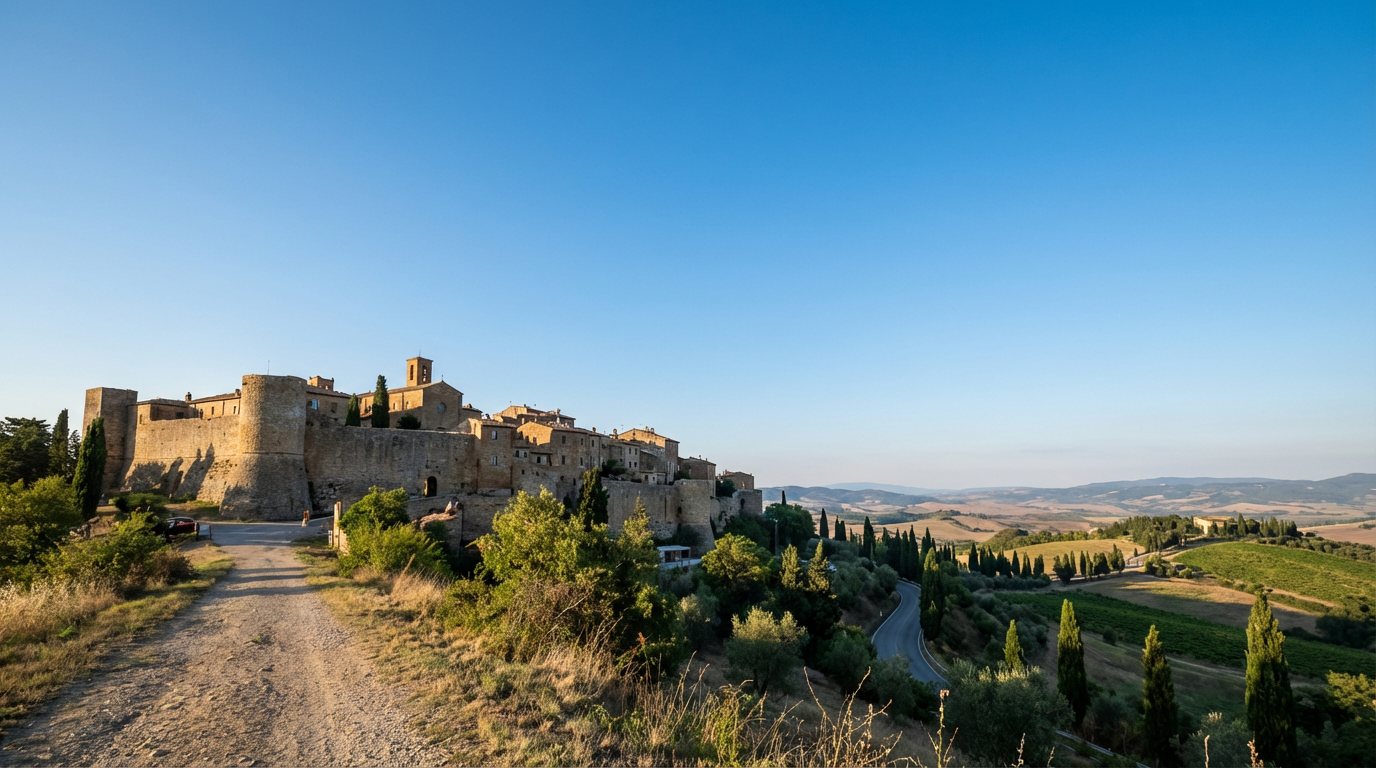
Pienza: what to see in Tuscany's ideal Renaissance city
Pienza is one of the few places in Tuscany that delivers fully on its reputation. Built almost entirely from scratch in the 15th century on the orders of a single pope, it is small enough to explore on foot and concentrated enough to understand quickly. Every building on the central square was designed according to the same proportional system. The streets run at deliberate angles to frame views of the Val d’Orcia landscape below. Even the choice of building stone — a warm, pale limestone — was not accidental.
From Barberino Val d’Elsa the drive is about 65 km and takes roughly 55 minutes, most of it on the SR2 south through Siena and then east on the scenic SP146 through the Val d’Orcia. The final approach into Pienza is one of the more satisfying road arrivals in central Italy: the town appears on its ridge above the wide-open valley and you understand immediately why the pope chose this spot.
Pienza: the ideal Renaissance city
Pope Pius II was born in 1405 in a village called Corsignano, a few hundred metres from where Pienza now stands. When he was elected pope in 1458, he had been living in Rome, Florence, and the courts of Europe for decades. He knew what a well-designed city looked like. He commissioned architect Bernardo Rossellino — a student of Leon Battista Alberti, the definitive theorist of Renaissance architecture — to transform his birthplace into a model of what an ideal city should be.
The construction ran from 1459 to 1462. In three years, Rossellino built a cathedral, a papal palace, a bishop’s palace, a town hall, and redesigned the main street and central square. Everything was built at the same time according to a unified design. The result is a coherence that most historic centres, assembled over centuries of competing decisions, cannot achieve.
Today Pienza has about 2,200 inhabitants. It was designated a UNESCO World Heritage Site in 1996 as part of the broader Val d’Orcia landscape. The historic centre is largely traffic-free during the day. You can walk from the main gate to the far end of town in under ten minutes. The main street, Corso il Rossellino, runs straight through the middle, lined with shops selling local food products, ceramics, and crafts.
The best time to visit is a weekday morning in spring or autumn. Summer weekends bring crowds to a space that was not designed for large numbers of people. Arriving before nine in the morning gives you the cathedral square almost to yourself.
The Cathedral and Piazza Pio II
The cathedral stands at the highest point of the central square and is the architectural heart of the town. Its facade is white stone, clean and composed, with classical proportions that reference ancient Rome without imitating it literally. This was deliberate: Rossellino and Pius II wanted a modern building in the antique spirit, not a reproduction.
Inside, the space is unusual for a Tuscan church of this date. The nave is wide and filled with light from high windows. Pius II had visited the Gothic churches of northern Europe on his travels and admired their luminosity. The Pienza cathedral interior reflects this preference: it is bright, airy, and notably un-Romanesque in its handling of space and light.
Five altarpieces were commissioned directly by Pius II, each from a different Sienese painter. Sano di Pietro, Giovanni di Paolo, Matteo di Giovanni, and their contemporaries each contributed a panel. The paintings are displayed in their original positions, creating a gallery of 15th-century Sienese painting integrated into the functioning architecture of the building. Entrance to the cathedral is free.
Piazza Pio II is one of the most harmonious small squares in Tuscany. The Palazzo Piccolomini on the left, the Palazzo Vescovile on the right, and the Palazzo Comunale across from the cathedral all face the same space with facades designed in deliberate relationship to one another. Standing at the centre of the square, you can see the proportional system at work — the way each building responds to the others in height, rhythm, and material.
Palazzo Piccolomini: what to see
The Palazzo Piccolomini was the private residence of Pius II and his family. It was designed by Rossellino directly after the Florentine Palazzo Rucellai, another Alberti-inspired building, and brought the northern Italian palace tradition to a Sienese hilltop town.
The building functions today as a museum. You can visit the papal apartments on the upper floors, which retain much of their original furniture, tapestries, and decoration. The scale is modest — this is a private residence, not a state palace — but the quality of the objects and the continuity of the interior atmosphere are genuinely affecting.
The most memorable feature is the hanging garden at the rear of the building. It occupies a terrace cantilevered on arches above the hillside and offers a view over the Val d’Orcia that on a clear day extends 40 or 50 kilometres south toward Monte Amiata. The garden was designed to be the private retreat of the pope, a place to sit, read, and look out over the landscape of his childhood.
The courtyard is visible from the street even if you do not buy a ticket. It shows the palazzo architecture at its most formal: classical columns, elegant proportions, a well in the centre that dates from the 15th century. Tickets cost around 7 euros per adult. Opening hours are Tuesday to Sunday, 10:00 to 18:00 in summer. The palace is closed Mondays and in February.
Pienza pecorino: where to buy it
No visit to Pienza is complete without buying cheese. The town’s identity as a producer of exceptional pecorino predates Pius II’s architectural campaign and has survived every subsequent change. The sheep’s milk cheese made in the Val d’Orcia around Pienza is among the most varied and carefully produced in Tuscany.
Corso il Rossellino has more cheese shops per hundred metres than almost any other street in Italy. The windows are stacked with wheels at different stages of ageing. The smell of aged sheep’s milk drifts into the piazza on warm days. Most shops offer tastings at the counter — not as a formality but as a practical way of helping you choose.
The main ageing categories are: fresco (20 to 30 days old, soft, mild, creamy), semi-stagionato (60 to 90 days, firmer, more developed), and stagionato (four months or more, dry, intense, crumbly). Local producers also age their cheese under wood ash, in walnut leaves, in terracotta, or coated in tomato paste. Each treatment changes the character of the rind and influences the interior.
Buy from shops that cut directly from the wheel. Avoid pre-sealed vacuum packs at the tourist end of the street. A 300-gram piece of good stagionato costs 8 to 12 euros. The Caseificio Cugusi on Via della Madonnina is one of the most respected names. La Bottega del Naturista near the main square is another reliable choice.
Also look for local honey, pici pasta, and Val d’Orcia olive oil. These travel well and are genuinely good.
What to do beyond the main sights
The town walls on the southern side of Pienza provide the best viewpoint in the Val d’Orcia. Walk the southern promenade and look out over the landscape below. In late spring the hills are vivid green. By mid-July they have turned gold. In October the light turns amber and the shadow lines across the clay hills become sharp and dramatic. This view does not require a ticket.
The Diocesan Museum next to the cathedral holds Flemish tapestries, illuminated manuscripts, and local church art accumulated over centuries by the diocese. It is small, rarely crowded, and worth an hour. Entrance costs around 4 euros.
The village of San Quirico d’Orcia is 9 km west of Pienza along the SP146. It has a Romanesque collegiate church with three extraordinary carved portals, a formal Renaissance garden called the Horti Leonini, and a pace of life even quieter than Pienza. It is worth an additional hour if your day has space for it.
For lunch in Pienza, Trattoria Latte di Luna on Via San Carlo is a reliable choice: traditional food, generous portions, around 30 to 40 euros per person with wine. Osteria Sette di Vino near the central square is smaller and more informal, at around 25 euros per person.
How to get there from Barberino Val d’Elsa
The most direct route from Barberino Val d’Elsa takes you south on the SR2 through Poggibonsi and Siena, then south-east on the SP146 Val d’Orcia road. This last stretch — from San Quirico d’Orcia to Pienza — is one of the most beautiful drives in Tuscany and should be driven slowly.
Total distance: approximately 65 km. Drive time: approximately 55 minutes without traffic. Allow extra time during Siena’s peak hours.
There is no practical direct public transport connection from Barberino Val d’Elsa to Pienza. A car is the only realistic option.
Parking is available outside the historic centre on the northern side near Porta al Prato. Most parking is free.
Where to stay
Sogno d’Oro in Barberino Val d’Elsa puts Pienza within an easy 55-minute drive. The route south through the Crete Senesi and the Val d’Orcia is itself part of the experience — the landscape changes character completely in the 30 kilometres between Siena and the southern hills.
Plan to arrive early, spend a full morning in the town and at the palazzo, buy cheese and local produce at midday, and drive back through the golden afternoon light of the Val d’Orcia.