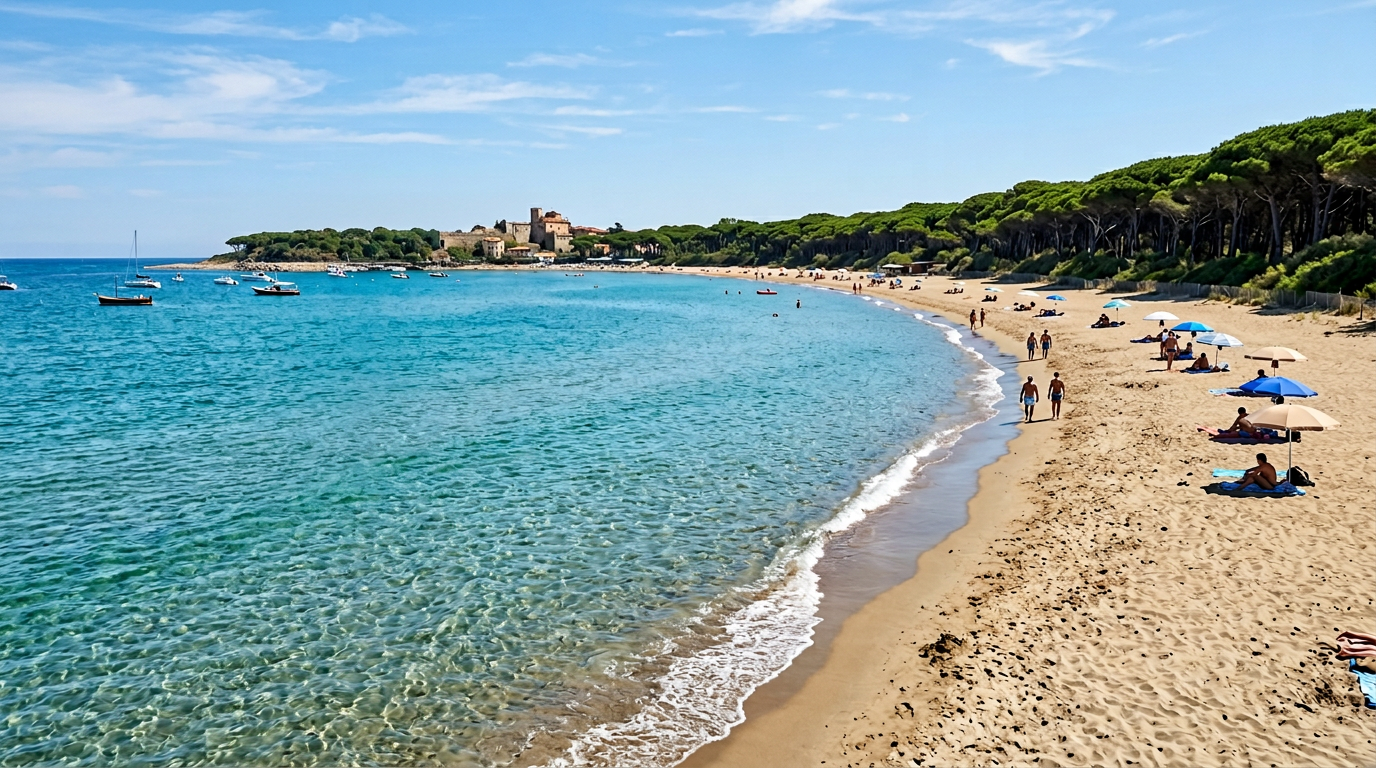
Castiglione della Pescaia beaches: planning a perfect sea day from Barberino
Castiglione della Pescaia is 130 kilometres from Barberino Val d’Elsa and roughly 90 minutes by car. That drive places it at the outer edge of a comfortable day trip, but it is one of the best beaches on the Tuscan coast, and the combination of fine sand, clean Tyrrhenian water, and a genuine medieval village on the promontory above makes the distance worthwhile.
The resort has been popular with Italian families for decades and maintains a character that is relaxed rather than brash. The facilities are well maintained, the food is good, and the old town on the hill above the beach is one of the most evocative on this stretch of coast.
Castiglione della Pescaia beaches
The coastal strip around Castiglione extends for several kilometres in both directions from the historic promontory. The main beach in front of the modern resort town is the most accessible and most developed. The sand here is fine and pale, and the sea is calm on most summer days because the bay is partially sheltered from the dominant northwest winds by the promontory itself.
Water quality on this stretch of the Maremma coast is consistently good. The beaches receive Blue Flag certification most years and monitoring by ARPA Toscana (the regional environmental protection agency) confirms low contamination levels at the main bathing points.
The sea temperature rises from around 22 degrees Celsius in early June to a peak of 25 to 27 degrees in late August and September. September is often the best month for a beach visit: the air is still warm, the crowds thin considerably after the Italian school holidays resume, and the water is at its hottest.
Free and paid beaches
The beach at Castiglione divides into two categories that matter practically for planning your day.
Stabilimenti balneari are private beach clubs that lease sections of the beach from the municipality and provide services including sun loungers, umbrellas, changing facilities with showers and lockers, and usually a bar or restaurant. Prices vary by club, location, and season. A setup of two sun loungers and one umbrella typically costs between 25 and 45 euros per day. Front-row positions closest to the water are more expensive. Paying for a beach club makes most sense if you plan to spend the full day and want reliable shade and somewhere to leave your belongings.
Spiagge libere, the free public beach sections, are interspersed along the coast between the private clubs. You are required to bring your own equipment — umbrella, towel, anything else you need. The free sections tend to fill quickly on summer mornings. If you plan to use a free beach in July or August, arrive by 9:00 at the latest to secure a usable position.
The beaches south of the main resort town, in the direction of the Diaccia Botrona lagoon, become progressively less developed and quieter. Some sections in this direction are backed by sparse pine forest rather than beach clubs. These are good choices for visitors who prefer a more natural setting and are willing to walk further from the parking area.
Punta Ala, about 12 kilometres north of Castiglione, is a different kind of beach: more upscale, with private clubs, a marina, and an atmosphere of affluent quietness. Worth considering if the busier Castiglione beaches feel too crowded on summer weekends.
The old town on the promontory
The medieval village of Castiglione della Pescaia stands on a headland above the modern resort below. It is entirely contained within its original walls, which are largely intact and create a clear boundary between the medieval and the modern. The view from the walls over the bay and the Tyrrhenian coastline is exceptional and justifies the walk up regardless of whether you spend time in the village itself.
The approach from the lower town takes about 15 minutes on foot up a road that steepens as it nears the gate. By car, you can drive up and park near the walls. Inside, the streets are steep and narrow, paved in stone, and lined with small houses that have changed little in structure since the medieval period. The village is compact enough to walk completely in 40 minutes.
The Torre Aragonese near the main entrance gate is a fifteenth-century fortification, one of several defensive structures added during the period of Aragonese and Spanish influence along this coast. A handful of restaurants, small shops selling local products, and a couple of cafes operate inside the walls. The selection is not large, which keeps the village from feeling like a commercial centre.
The best time to visit the village is either early in the morning before the beach crowds arrive, or in the early evening when the day-trippers have left and the light on the western walls is golden. From the southern ramparts on a clear day the view extends to the island of Giglio and, in good visibility, to the outline of Monte Argentario.
How to organise a day at the sea
The most practical structure for a Castiglione day trip from Barberino is to plan the beach in the morning and the village in the afternoon or evening.
Leave Barberino by seven in the morning to arrive at the beach by around eight-thirty. This gives you time to choose a spot on the free beach or check into a beach club before the mid-morning influx. Morning swimming is generally calmer and the light is better for the water.
Have lunch either at a beach club restaurant or at one of the seafood places near the beach. Local specialties on this coast include spaghetti alle vongole, grilled fish of the day dressed with local olive oil and lemon, fried anchovies, and the regional flatbread schiacciata, which is sold from bakeries near the beach as a simple and satisfying lunch.
In the afternoon heat, from roughly 13:00 to 16:00, the beach is least comfortable. Use this time to visit the old village on the promontory. Walk the walls, have a coffee in the shade, and explore the streets. By four o’clock the beach is pleasant again for a final swim.
Leaving by 19:00 allows a return to Barberino Val d’Elsa before dark.
How to get there from Barberino Val d’Elsa
Take the SR2 Cassia south from Barberino, passing through Poggibonsi, continuing south past Siena, and following the road toward Buonconvento and Grosseto. Before reaching the city of Grosseto, turn west on the Via Aurelia (SS1) north toward Follonica, and then follow signs south to Castiglione della Pescaia.
Alternatively, take the E78 expressway from the Colle Val d’Elsa junction directly west toward Grosseto, which avoids passing through Siena and can be faster during busy summer weekends.
Total distance from Barberino: approximately 130 kilometres. Driving time: 90 minutes in normal conditions.
In high summer the coast roads south of Follonica and approaching Castiglione from the north can be congested on Saturday mornings. Arriving before nine avoids the worst of this.
Parking near the beach in July and August costs three to four euros per hour in the paid zones closest to the seafront. Free parking is available further back, within walking distance. Arrive early to find a space without difficulty.
Where to stay
Sogno d’Oro guesthouse sits in the Val d’Elsa countryside near Barberino Val d’Elsa. The drive to Castiglione della Pescaia is 90 minutes, making it a full but worthwhile day away from the hills. The contrast between the inland Chianti landscape and the Maremma coast is one of the pleasures of staying in this part of Tuscany: you can have sea in the morning and vineyards in the evening without covering excessive distances.