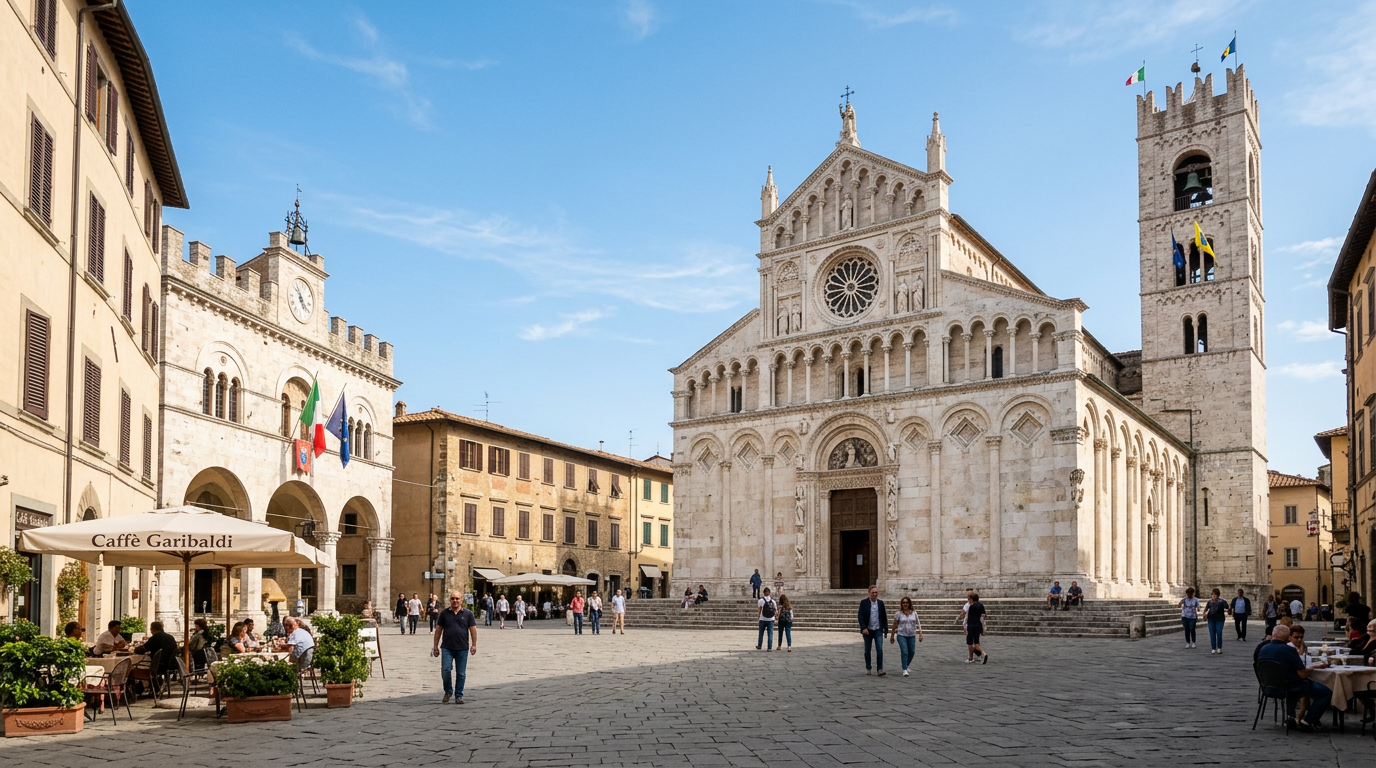
Massa Marittima: the Maremma's medieval city of mines, art, and quiet piazzas
Massa Marittima is 90 kilometres from Barberino Val d’Elsa and 75 minutes by car. The distance puts it toward the outer limit of a manageable day trip, but the journey is rewarded by one of the most coherent and least visited medieval cities in Tuscany. While the better-known hilltowns to the north absorb steady flows of visitors, Massa Marittima receives a fraction of that traffic and maintains an atmosphere of genuine daily life within its medieval walls.
The city sits in the Colline Metallifere — the metalliferous hills — a range of low mountains in the province of Grosseto that takes its name from the mineral deposits exploited here since the Etruscan period. Copper, silver, lead, and iron shaped the wealth and history of this place in ways that are still visible in the urban fabric and the landscape.
Massa Marittima: the hidden gem
The city divides into two distinct elevations. The Città Vecchia, the older lower town, contains the main square and cathedral and dates primarily from the communal period of the twelfth to fourteenth centuries. The Città Nuova, the upper extension, was added when the city expanded in the thirteenth century during its period of greatest wealth and independence. The two sections are connected by a steep street and by steps carved into the hillside.
Massa Marittima was an independent commune from the early thirteenth century. It issued its own coinage, enacted its own laws, and built a cathedral and civic complex that expressed the confidence and resources of a city that had become wealthy from mining. The 1310 mining code enacted here, the Codice Minerario, was one of the earliest systematic bodies of mining law in Europe and was influential across the region.
The city lost its independence to Siena in 1335, after which the pace of construction slowed and the population declined. This historical trajectory — a burst of communal energy followed by absorption into a larger state — is largely responsible for the extraordinary coherence of the medieval centre. The buildings were built quickly, in a concentrated period, and then left largely unchanged.
Population today is around 8,500. The city has a small university presence, a local food and wine culture centred on Morellino di Scansano and local Maremma products, and a tourism infrastructure sufficient for comfortable visits without being oriented entirely around visitors.
Piazza Garibaldi and the Cathedral
Piazza Garibaldi is the central space of the Città Vecchia and one of the finest medieval squares in Italy. The proportions are unusual: the piazza narrows slightly as it rises toward the cathedral, creating a funnel effect that draws the eye toward the facade. The surrounding buildings — the Palazzo del Podestà, the Palazzo dell’Abbondanza, and the houses on the flanking streets — form a coherent ensemble that feels designed as a whole rather than accumulated over time.
The Cathedral of San Cerbone was built in phases between the eleventh and fourteenth centuries. The lower section of the facade is Pisan Romanesque, with blind arcading and a carved doorway typical of the style. The upper section transitions into Gothic, with pointed arches and a different handling of the surface. Despite the difference in period and style, the facade reads as harmonious, partly because the consistent use of local limestone ties the elements together.
Inside the Cathedral, the Arca di San Cerbone is the principal object of attention. This carved marble sarcophagus was completed in 1324 by Goro di Gregorio, a Sienese sculptor working in a tradition that draws on Nicola and Giovanni Pisano. The relief carvings on the sides of the sarcophagus depict scenes from the life of the local bishop saint with exceptional detail: the figures are expressive, the spatial organisation is sophisticated, and the narrative is coherent even without a guide.
Also in the Cathedral is a panel painting of the Madonna delle Grazie attributed to Duccio di Buoninsegna, dating from around 1316. This small painting has the gold background, the tender tilt of the head, and the refined draughtsmanship typical of the greatest Sienese painter of the period.
The Museo Civico in the Palazzo del Podestà on the piazza holds the Maestà of Ambrogio Lorenzetti, a large altarpiece painted in 1335. Lorenzetti was one of the two great Sienese painters of the fourteenth century alongside Simone Martini, and this Maestà is one of his major surviving works outside the Palazzo Pubblico in Siena. Tickets cost around five euros.
The Mine and sacred art museum
The Museo delle Miniere is one of the most unusual museums in southern Tuscany. It occupies an actual network of tunnels excavated into the hill beneath the Città Vecchia. These were working mine galleries used historically for the extraction of the mineral deposits that made Massa Marittima prosperous.
Guided tours take visitors through approximately 700 metres of tunnel, passing reconstructed equipment, geological exhibits, and explanations of how different materials were extracted and processed over the centuries from the medieval period through the industrial era. The temperature inside the tunnels remains around 14 degrees Celsius year-round regardless of the season outside. Bring a layer.
Tours run regularly from 10:00 through 17:00 in summer (shorter hours in winter). Tickets cost around eight euros for adults and five euros for children. The tour lasts approximately 50 minutes. It is suitable for children of school age and above and does not require any physical exertion beyond walking.
The Museo di Arte Sacra, housed in the former convent of San Pietro all’Orto near the main piazza, contains religious works from churches in Massa Marittima and the surrounding territory spanning the thirteenth to eighteenth centuries. The collection includes a second important altarpiece attributed to Ambrogio Lorenzetti and various devotional paintings, sculpture, and liturgical objects from local churches. Entrance is combined with the Museo Civico ticket or available separately.
The Fortezza dei Senesi in the Città Nuova upper district is a fourteenth-century fortification with a dramatic external arch bridge connecting two tower structures across a gap. It is visible from several points in the lower city and worth the walk up for the view back over the Città Vecchia from the ramparts.
What to do in the area
The Parco Naturale delle Colline Metallifere covers the hills around Massa Marittima with marked trails for walking and mountain biking, areas of protected woodland, and habitats that support birds of prey and other wildlife. The park office in the city provides maps and route descriptions.
The thermal springs at Petriolo, about 30 kilometres east of Massa Marittima, offer free natural pools in the Farma river gorge where the water flows at around 43 degrees Celsius. This is a popular local destination on weekends and can be busy in summer, but on a weekday in late spring or early autumn it is a genuine pleasure.
Follonica, about 25 kilometres south, is the nearest seaside town. The beaches are clean and the sea is good quality. Useful if you want to extend a Massa Marittima day with an afternoon at the coast, though Follonica itself has little of architectural interest.
For lunch in Massa Marittima, the restaurants and trattorias on and near the piazza serve straightforward Maremma cooking: wild boar ragù, pork preparations using local breeds, and whatever vegetables are in season. Prices are modest. Expect around 25 to 35 euros for a full meal with wine.
How to get there from Barberino Val d’Elsa
The most direct route from Barberino Val d’Elsa heads south on the SR2 through Poggibonsi. Continue south past Siena on the raccordo ring road and continue toward Buonconvento on the SR2. At Buonconvento, or shortly before, take roads west toward Monticiano and then follow signs southwest toward Massa Marittima through the Colline Metallifere. The final approach on the SP39 involves winding hillside roads that require attentive driving but are not technically difficult.
An alternative avoids central Siena by taking the A1 motorway south from Poggibonsi to the Colle Val d’Elsa exit and heading west from there. This adds some distance but can be faster in summer when Siena’s ring road is congested.
Allow 75 minutes each way. A car is strongly recommended. Public transport between Barberino and Massa Marittima involves multiple connections and takes well over two hours.
Where to stay
Sogno d’Oro guesthouse, set in the Val d’Elsa countryside near Barberino Val d’Elsa, is a comfortable base for a full day in Massa Marittima. Leave in the morning, spend the day in the city, have dinner before returning, and arrive back in the Val d’Elsa in the early evening. The contrast between the vine-covered hills of the Chianti and the rougher, mineral-rich landscape of the Maremma is one of the most interesting experiences of a day trip in this direction.