Truffle in Tuscany: where to find it, hunt it, and eat it well
Tuscany produces truffles across multiple seasons, in multiple zones, in varieties that range from the affordable scorzone of summer to the extraordinary white truffle of autumn. If you understand which variety grows where and when, and know how to access the markets, hunts, and restaurants that take the product seriously, the truffle experience in Tuscany is both more accessible and more layered than most visitors realise.
From Barberino Val d’Elsa you are well positioned. The Crete Senesi truffle grounds are about 50 kilometres south. The San Miniato white truffle zone is about 45 kilometres northwest. The Val d’Elsa itself has wooded areas that produce truffle in good years, and local specialists who know where to look.
Truffles in Tuscany
The truffle calendar in Tuscany covers almost the entire year if you know which variety to follow.
The marzuolo, or spring truffle, grows from January through April. It resembles the white truffle in external appearance, with a pale, irregular surface, but has a softer and more earthy flavour without the intensity that makes the white truffle so prized. It is affordable and rarely exported, which means eating it in Tuscany in March is a genuinely local experience.
The scorzone estivo, or summer black truffle, grows from May through September. It has a rough, pyramidal-warted surface and a mild, pleasantly mushroomy flavour. It is the most widely available and affordable truffle in Italian cooking, used by restaurants and home cooks throughout the summer. It is a good truffle for cooking — useful in sauces, pasta fillings, and on eggs — even if it lacks the raw intensity of the winter varieties.
The uncinato, an autumn black variety, grows from October through December and has a slightly stronger character than the scorzone. It bridges the gap between the summer black and the winter black.
The pregiato nero, or Norcia black truffle, is the most prized of the black varieties. It grows from November through March and has a complex musky, earthy, and faintly chocolatey aroma that develops with gentle heat. San Giovanni d’Asso in the Crete Senesi, about 50 kilometres from Barberino, is one of the primary production centres.
The tartufo bianco, or white truffle, is the most celebrated and expensive. Found from October through December in specific zones with the right combination of woodland, soil humidity, and host tree root systems, it commands prices that range from 2,000 to 5,000 euros or more per kilogram depending on the season. Even a few grams shaved over warm, buttered pasta is enough to understand why.
The richest truffle areas
The Crete Senesi, the zone of pale clay erosion hills south and east of Siena, is the richest truffle territory in Tuscany. The combination of calcareous clay soil, sparse woodland, and specific microclimate creates ideal growing conditions for both black and white varieties. The towns of Asciano, San Giovanni d’Asso, and Trequanda sit at the heart of this zone.
San Giovanni d’Asso, about 50 kilometres southeast of Barberino Val d’Elsa, is the historical centre of Tuscan black truffle production. The town has a small but genuinely excellent truffle museum housed in a medieval castle. The museum explains the ecology of truffle growth, the history of the Crete Senesi truffle trade, and the biology of the symbiotic relationship between the fungus and its host trees. For visitors who want to understand rather than simply taste, it is an excellent starting point.
San Miniato in the lower Arno valley, about 45 kilometres northwest of Barberino, is the Tuscan centre for white truffle. The rolling hills around the town produce specimens that are compared, by enthusiasts, with the more famous production from Alba in Piedmont. The San Miniato white truffle fair in November is one of the most important seasonal food events in central Italy.
The Val d’Elsa itself has truffle grounds, particularly in the wooded areas between Barberino, Certaldo, and Castelfiorentino. These are not mapped or publicised. Trifolai, truffle hunters, guard their locations with the proprietary devotion of a fisherman protecting a favourite stretch of river. But the truffle is there, and local specialists can access it.
Truffle markets near Val d’Elsa
The San Miniato Mostra Mercato Nazionale del Tartufo Bianco is the most significant truffle market within reach of Barberino Val d’Elsa. It takes place over three consecutive weekends in November, with truffle sellers, cooking demonstrations, wine tastings, and themed restaurant menus throughout the town. Buying directly from hunters at the market allows you to examine specimens, compare prices, and understand what distinguishes a superior truffle from an ordinary one. The smell alone, when you hold a good white truffle close, is an education.
San Giovanni d’Asso holds its Mostra Mercato del Tartufo in November, smaller and less crowded than San Miniato, with a correspondingly more relaxed atmosphere. If you want time to ask questions and understand what you are buying, San Giovanni d’Asso is often a better choice.
Volterra, about 35 kilometres west of Barberino, hosts autumn truffle events in October and November. The setting inside one of Tuscany’s great Etruscan and medieval cities adds considerable atmosphere to the market experience.
Outside of dedicated fairs, local alimentari and delicatessens in the Val d’Elsa carry truffle products year-round: truffle-infused salt, truffle paste in glass jars, and truffle oil. A word of warning about truffle oil: the overwhelming majority of commercial truffle oils are flavoured with synthetic 2,4-dithiapentane, a laboratory compound that mimics one aromatic component of truffle without any actual truffle content. If the price is low and the ingredients list only olive oil and “truffle aroma”, it is synthetic. Real truffle oil, with actual pieces of truffle in the bottle, is significantly more expensive and has a more complex flavour.
How to join a truffle hunt
Organised truffle hunts for visitors are offered by agriturismi and specialist operators throughout the Chianti and Crete Senesi areas. These are genuinely worthwhile experiences that are impossible to replicate through a market visit alone.
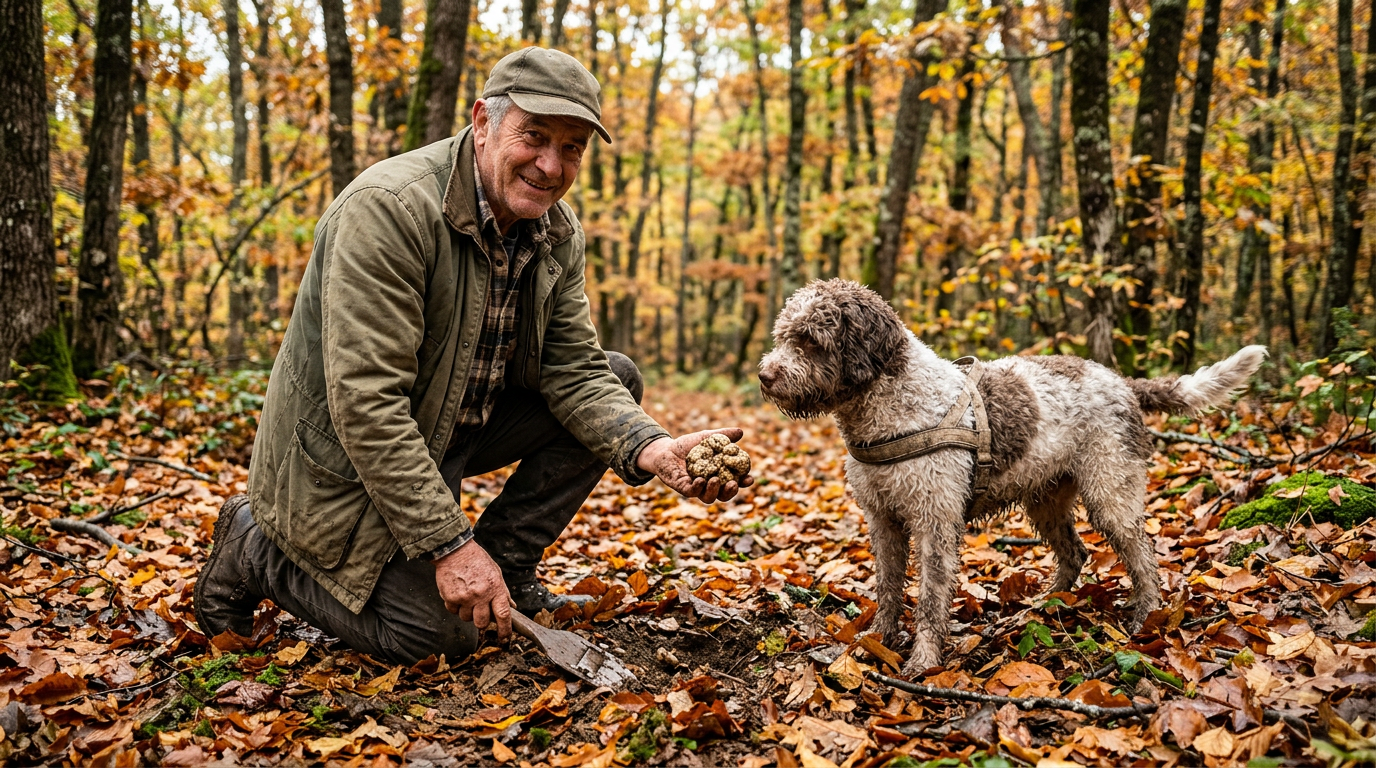
A standard hunt lasts two to three hours and is led by an experienced trifolao accompanied by at least one trained dog. Lagotto Romagnolo is the breed most commonly used in Tuscany: medium-sized, curly-coated, and possessed of a nose of extraordinary sensitivity. The dog does the hunting. The trifolao follows and uses a vanghetto, a small forked spade, to carefully extract the truffle from the soil without damaging it.
You will walk through woodland on uneven ground. In autumn this means potentially muddy and wet conditions. Wear sturdy shoes and bring a layer. The experience is not glamorous. It is physical, slow, and requires patience. When the dog stops, signals, and begins to scratch, the moment of anticipation is real.
Most organised hunts include a lunch or aperitivo at the end, featuring dishes made with the truffle found that morning. Bruschetta with fresh truffle shavings, scrambled eggs with white truffle, or fresh pasta dressed simply are typical. The immediacy of eating something found an hour earlier is one of those experiences that stays with you.
Prices for a small group hunt with meal range from 60 to 120 euros per person. Book in advance. November visits require earlier booking as demand during the truffle season is high. Ask at Sogno d’Oro about operators who work in the immediate Val d’Elsa area.
Restaurants where to eat it
Fresh truffle dishes require a restaurant that sources actively from local hunters rather than from jarred or frozen product. The distinction is enormous. A shaving of fresh white truffle over warm, buttered tagliatelle has an aroma that fills the room and a flavour that penetrates the pasta immediately. The same dish made with preserved truffle is a shadow of itself.
In the Val d’Elsa area, several trattorias and small restaurants in Barberino Val d’Elsa, Tavarnelle, and San Donato in Poggio serve seasonal truffle dishes from October onward. Ask explicitly whether the truffle is fresh and locally sourced. A kitchen that uses fresh product will answer this without hesitation and with some pride. If the answer is vague or deflecting, choose something else.
Pici al tartufo, hand-rolled pasta with truffle shaved at the table, is the most common preparation and one of the best. The thick pasta and its sturdy texture hold up well to the strong flavour. Uova strapazzate al tartufo bianco, gently scrambled eggs with white truffle, is considered by connoisseurs the most honest preparation, because the neutrality of butter and eggs offers no competition to the truffle’s own character.
Where to stay
Sogno d’Oro in Barberino Val d’Elsa sits within easy reach of both the Crete Senesi truffle grounds and the San Miniato white truffle fair. The guesthouse is close enough to the Val d’Elsa woodland areas to arrange a local hunt during your stay without a long drive.
Autumn in this landscape, when the truffle season is at its peak, is one of the most rewarding times to visit Tuscany. The light is extraordinary, the crowds are gone, and the food calendar is at its richest.