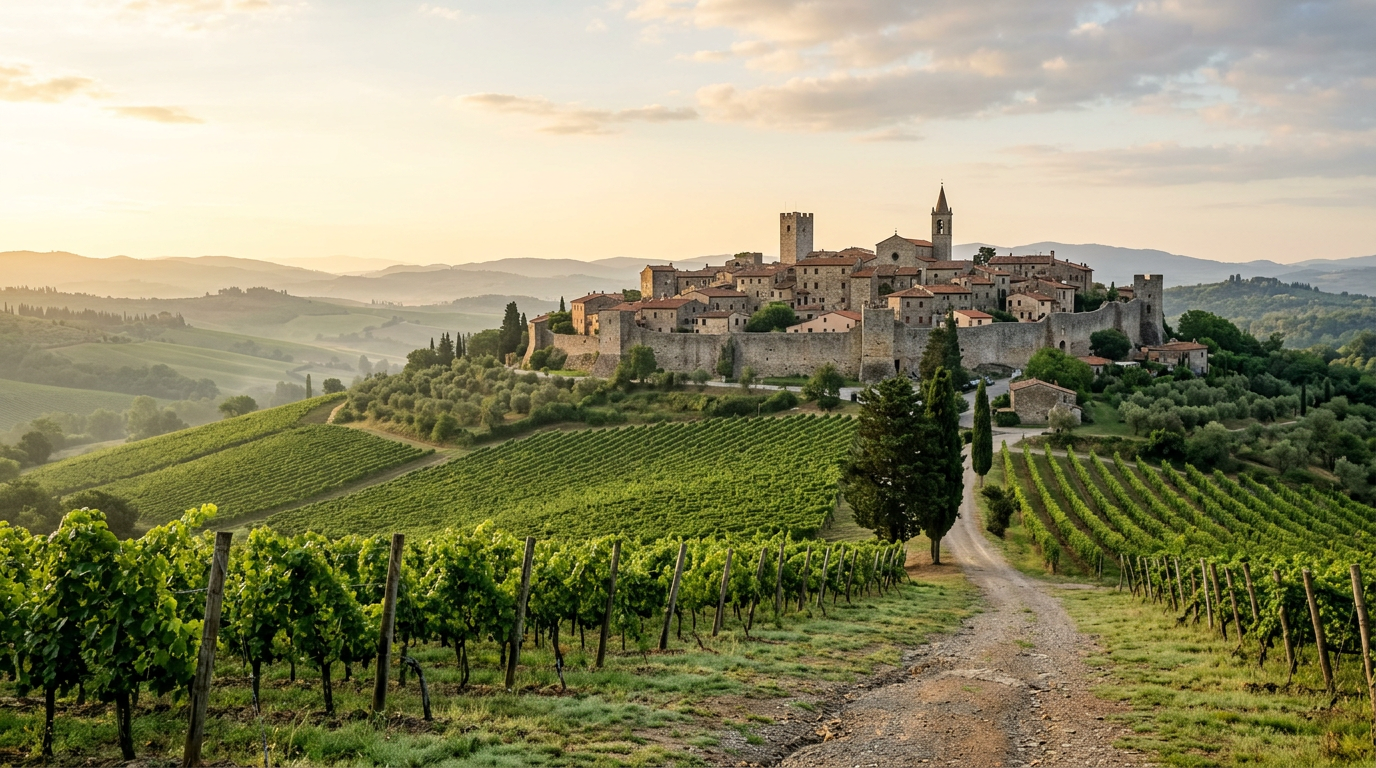
Radda in Chianti: what to do for a perfect day in wine country
Radda in Chianti is one of those towns that gets under your skin quietly. It does not shout for attention the way Florence does, nor does it make a show of its wine heritage. It simply sits at 530 metres above sea level, between the Pesa and Arbia valleys, and waits for you to arrive, slow down, and notice what is actually there.
The town is small — about 1,600 residents — and it is perfectly sized for a day on foot. From Barberino Val d’Elsa, Radda is 28 km to the east, a 30-minute drive along roads that pass through some of the most classic Chianti Classico landscape in the region. You go through San Donato in Poggio, climb into the hills, pass vineyard rows, farmhouses, and cypress windbreaks, and arrive at the edge of a town that has been making wine here for centuries.
Radda in Chianti: what to do
The first thing to understand about Radda is its pace. This is not Greve in Chianti, which has a more prominent market square and a higher tourist volume. Radda is more residential, more self-contained. The shops serve people who actually live here. The Thursday market is a food and general goods market for the valley, not a souvenir fair.
This quality — quiet functionality alongside genuine quality — makes Radda the right choice for travellers who want to understand how Chianti actually works rather than simply experiencing its postcard version.
Start the morning with coffee in Piazza Ferrucci, the main square. The cafes here are unhurried. If you arrive early enough you will find locals on their way to work, picking up a cornetto and an espresso before heading out toward their farms or offices. After coffee, walk the main street and the alleys that branch off it. The town is compact enough that there is no need for a map.
The Thursday market offers a chance to buy local produce directly from small farmers and suppliers. Arrive before ten in the morning to get the best of what is available.
The Enoteca la Botte on Via XX Luglio stocks bottles from a wide selection of local estates. This is a good place to taste before buying and to ask for recommendations tailored to your preferences. The staff know their producers personally.
Intact medieval centre
Radda’s historic centre survived the 20th century in remarkable condition. The town walls are largely complete. Two main gates remain: Porta Fiorentina to the north and Porta Senese to the south. Walk the circuit outside the walls, which takes about 20 minutes, and you will have continuous views over vineyard-covered slopes on every side.
The Palazzo del Podesta on Piazza Ferrucci is the defining building of the town. Its facade is covered with ceramic coats of arms from the families and institutions that governed the area over the centuries — a visual archive of medieval power in a space you can cross in ten seconds. A covered passageway runs through the ground floor of the building, connecting the square to the alley behind. Few buildings in Chianti have such an unusual and practical architectural quirk.
The streets inside the walls are narrow and largely residential. There are no large souvenir shops here, no reconstructed medieval experiences. A few wine shops and a small number of restaurants operate with discretion. The feeling is of a place where people live rather than a destination assembled for consumption.
The Church of Santa Maria in Prato, just south of the walls, holds a 15th-century tabernacle with a fresco attributed to the Florentine school. The building is modest in scale but often open during daylight hours, and the quality of the painting inside merits five minutes of attention.
Chianti Classico wineries
The territory of Radda in Chianti produces wines that are consistently regarded as among the finest in the DOCG. The altitude here is higher than in the Greve area, and the predominance of Galestro and Alberese soils — thin, rocky, and well-draining — encourages vines to root deeply and concentrate their energies. The wines tend toward elegance and mineral precision rather than the rounder, more fruit-forward style of lower-altitude sites.
Castello di Volpaia is the most celebrated producer in this sub-zone. It is located 6 km north of Radda in the medieval hamlet of Volpaia, and its winery occupies stone buildings inside the village walls. The Chianti Classico Riserva is the benchmark wine. Visits run by appointment, typically around 25 euros per person. Book at least a week ahead during the main season.
Vignavecchia is a smaller family estate close to town. Their Chianti Classico is precise and well-balanced, and the welcome here is genuinely warm. Monteraponi is another small producer in the Radda orbit, farming biodynamically and making wines of great finesse and mineral character. Both require advance booking.
For a more spontaneous option, the enoteca in the main piazza sells wines by the glass from multiple local producers. A short tasting here can help you decide which estates to visit next.
Walking and cycling routes around the village
Radda is the ideal base for physical exploration of the Chianti hills. The combination of white gravel roads, forest tracks, and vineyard lanes gives walkers and cyclists of any fitness level something to work with.
The most popular walk is the trail to Volpaia, which covers about 6 km through oak forest and opens onto long vineyard views before arriving at the hamlet. At a comfortable pace, allow 90 minutes one way. The return can be varied via a different path.
A longer circuit of roughly 18 km links Radda to the Montevertine estate — producer of one of the most storied Super Tuscan wines — and back through the rolling countryside north of the town. This is suitable for fit walkers and mountain bikes. Allow four to five hours.
For cyclists, the SR429 between Radda and Gaiole passes through genuinely beautiful Chianti terrain. The road has climbs and descents but nothing extreme. A gravel bike handles the surface well outside the wet season. Electric bikes, available for rent from several estates in the area, open the routes to a wider range of riders.
The tourist office in Radda can provide current trail maps and updated rental information for bikes and e-bikes.
How to get there from Barberino Val d’Elsa
Radda in Chianti is 28 km from Barberino Val d’Elsa. The drive takes approximately 30 minutes by car.
The most direct and scenic route heads south-east from Barberino on the SP1 toward San Donato in Poggio, then east through Panzano and Greve in Chianti, then south-east on the SR429 to Radda. This road passes through the full character of the Chianti Classico landscape.
An alternative via Poggibonsi and the SR222 is slightly less twisting but not much faster. It bypasses Panzano and Greve, which are worth seeing in their own right.
Public transport to Radda is extremely limited. A car is the only practical means of visiting.
Parking is available outside the town walls in free car parks. From the nearest car park the town centre is a two-minute walk.
Where to stay
Sogno d’Oro is positioned near Barberino Val d’Elsa, at the western edge of the Chianti Classico zone. Radda is 28 km to the east, deep in the wine hills. The drive between the two takes 30 minutes through landscape that justifies slowing down.
Plan a full day: morning coffee in the square, a cellar visit in late morning, lunch at a winery or a simple trattoria in town, and a walk or cycle through the countryside in the afternoon. Return to the Val d’Elsa in the evening with a bottle or two and a better understanding of why Chianti Classico commands the attention it does.