Pienza pecorino: where to buy the best and how to choose
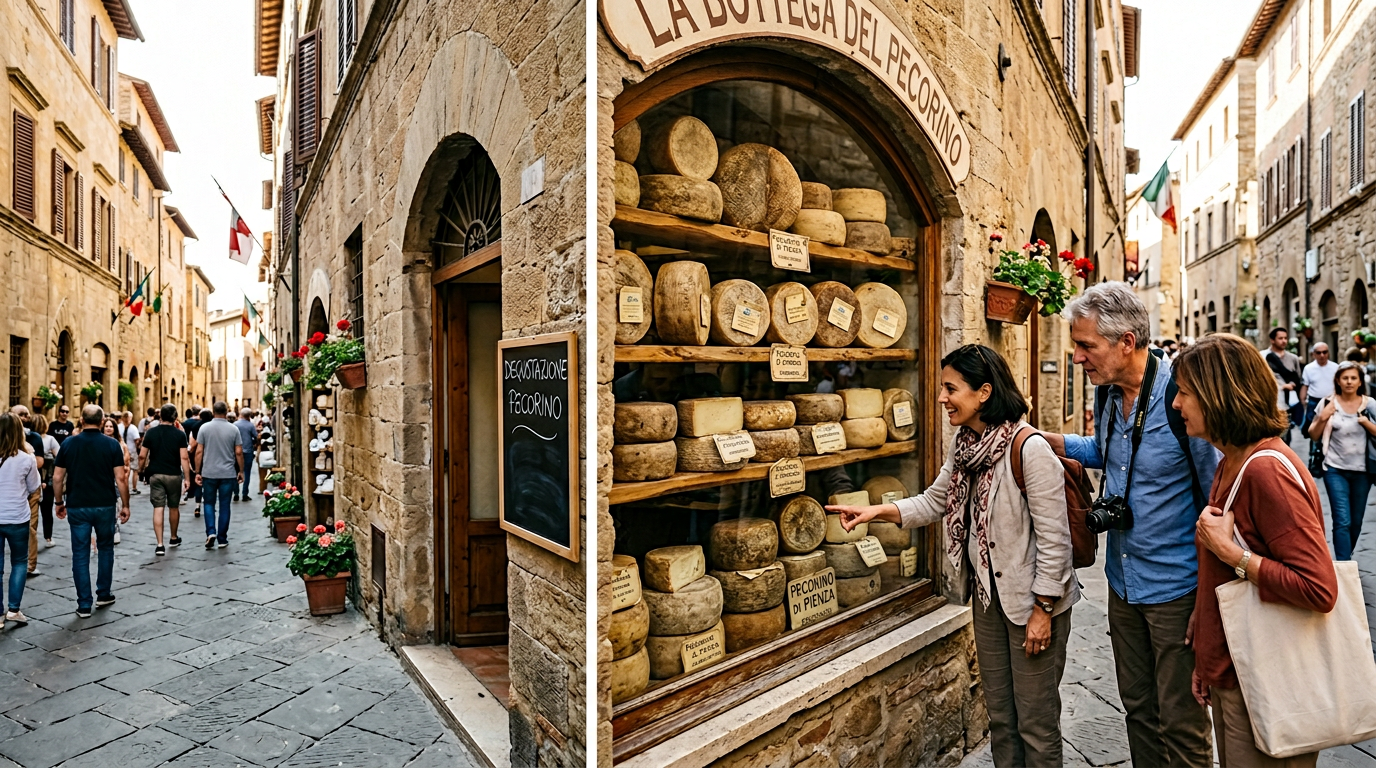
When people ask what food to bring back from Tuscany, the answer is almost always the same: pecorino from Pienza. The town’s main street is lined with specialist cheese shops selling sheep’s milk cheese at every stage of ageing — from the soft, pale rounds of fresco to the dark-crusted, crumbly wheels of fully aged stagionato that smell of dried herbs and dry stone rooms.
From Barberino Val d’Elsa the drive to Pienza is about 65 km and takes roughly 55 minutes, heading south on the SR2 through Siena and then east on the SP146. The Val d’Orcia road that connects San Quirico d’Orcia to Pienza is one of the most beautiful in Tuscany, which makes the journey itself part of the experience.
Pienza pecorino where to buy it
The term “Pienza pecorino” is not a strictly defined PDO like the broader pecorino toscano DOP, but rather a category of sheep’s milk cheese produced in the Val d’Orcia area, particularly around Pienza, using traditional methods and local breeds. What unites these cheeses is the quality of the raw material — the milk from sheep grazing on the uncultivated pastures and aromatic scrub of the Val d’Orcia — and the craftsmanship of the small caseifici (dairies) that have been working this territory for generations.
The best approach to buying pecorino in Pienza is to walk the length of Corso il Rossellino — the main street that runs from the town gate to the central square — and stop at the shops that cut directly from whole wheels. A shop that only sells pre-cut vacuum-packed portions is telling you something about how it values its product. A shop with a marble counter, a cheese wire, and staff who can describe each wheel by producer, age, and feed type is the one worth spending time in.
Avoid the shops clustered very close to the main gate, which tend to cater to groups with limited time. Moving 40 to 60 metres further into the street, toward the cathedral, brings you to dealers with more focused and more serious selections.
Ask for a taste before buying. This is expected. A good shop will offer you a small sliver of two or three different cheeses without requiring you to commit to a purchase. Use this to orient yourself before spending money.
Shops and delicatessens in the centre
Several family-operated shops in Pienza have been trading for decades. They are not souvenir shops with some cheese on the side. They are specialist dealers who select, age, and sometimes produce their own stock, and who maintain direct relationships with farms in the Val d’Orcia.
The Caseificio Cugusi on Via della Madonnina is one of the most respected names in Pienza. They age their own cheese and can describe each piece with precision: the farm, the milk, the age, the treatment. Their stagionato is consistently excellent.
La Bottega del Naturista near the main square carries a wide range of ageing levels and is a reliable second choice. The staff here are patient with questions and knowledgeable about pairing.
In both shops, expect to pay around 15 to 25 euros per kilogram for mid-range aged pecorino. A piece of 300 to 500 grams is a practical size — enough for a couple to enjoy over a week at home without waste.
Different ageing types
Understanding the main ageing categories helps you buy with intention rather than guessing.
Fresco is aged for 20 to 30 days. The rind is pale yellow or off-white. The interior is soft and white, with a mild, milky flavour and a hint of grassy sweetness. This is the most delicate and most perishable form. Buy it only if you plan to eat it within 48 hours of purchase. It is excellent with fresh local honey or sliced alongside ripe pears and figs.
Semi-stagionato is aged for 60 to 90 days. The rind has darkened to a light brown. The interior is firmer and slightly yellowish. The flavour has developed more complexity — a cleaner, sharper sheep character with a mild savoury quality. This is the most versatile type. It works as a table cheese, melts well in cooking, and pairs with both white and red wine.
Stagionato has been aged for four months or more. The rind is dark and hard. The paste inside is dry, granular, and breaks rather than slices. The flavour is intense: strong savoury and nutty notes with a long finish and a sharpness that leaves a pleasant warmth on the palate. This is the cheese for travelling with. It keeps for weeks and improves slightly in the first days after purchase.
Sotto cenere (under ash) is a specific local variant. The cheese is coated in wood ash during ageing, which creates a distinctive grey exterior and moderates the development of the rind. The interior tends to be slightly drier and more mineral than plain stagionato. If you have not tasted this form before, it is worth trying a small piece.
How to pair pecorino
Fresh pecorino asks for contrast: mild honey, fresh fruit, and light white wine that does not compete with its delicacy. Vernaccia di San Gimignano works well. So does a simple Vermentino.
Semi-aged pecorino is the most food-friendly form. It pairs with Chianti Classico alongside a mixed antipasto. It slices well for a quick lunch with crusty bread and cured meat. It melts into pasta and baked dishes without overwhelming the other ingredients.
Fully aged stagionato is the most demanding pairing partner. Its intensity needs something of equal strength. Chestnut honey — dark, slightly bitter, deeply aromatic — is the classic local accompaniment. A thin slice of aged pecorino, a spoonful of chestnut honey, and a glass of Brunello di Montalcino or a well-aged Chianti Classico Riserva is one of the most satisfying simple food experiences the Val d’Orcia produces.
Avoid pairing stagionato with delicate or neutral foods. Its flavour will simply overwhelm them. It needs companions with equivalent character.
How to get there from Barberino Val d’Elsa
Take the SR2 Cassia south from Barberino through Poggibonsi and Siena. Follow the Siena ring road south, continuing toward Buonconvento. At Torrenieri, take the road east toward San Quirico d’Orcia and then the SP146 to Pienza. The total distance is about 65 km.
Drive time is approximately 55 minutes in normal traffic. Allow 10 extra minutes during Siena morning peak hours.
Parking is available in car parks outside the historic walls. The main options are on the north and east sides of the town. The historic centre is restricted to residents and authorised vehicles — park and walk from the nearest gate.
Arriving before ten in the morning is strongly recommended. The food shops open by nine and the first hour is significantly quieter than the rest of the day. You can browse and taste without crowds and complete your purchases before the main visitor flow arrives.
Where to stay
Sogno d’Oro in Barberino Val d’Elsa is 55 minutes from the cheese shops of Pienza. The guesthouse makes an ideal base for combining a morning of food shopping in Pienza with the wider Val d’Orcia landscape — Montalcino, San Quirico d’Orcia, Bagno Vignoni — on the same day, returning in the evening with a selection of cheese, local honey, and perhaps a bottle of Brunello.