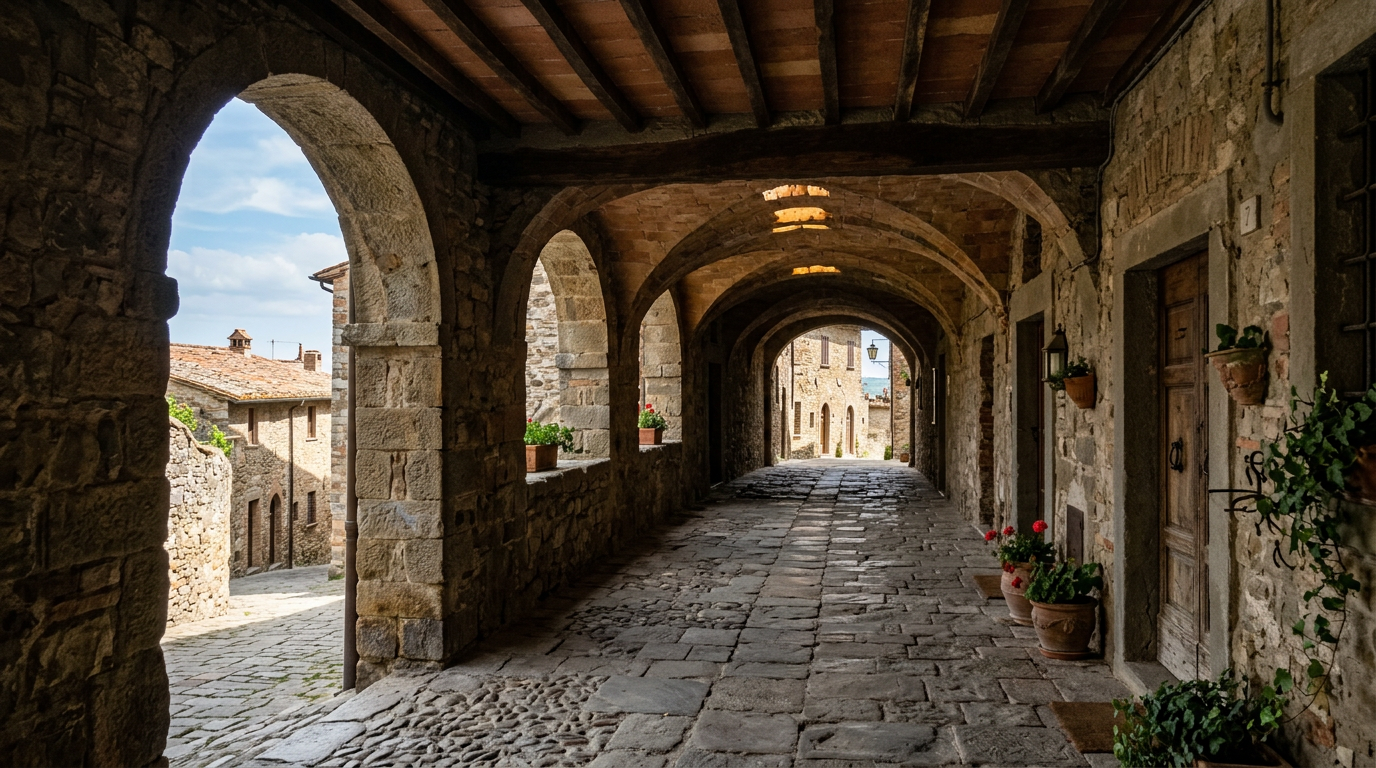
Castellina in Chianti: fortress, wine, and walkways
Castellina in Chianti stands at 578 metres on a ridge between the Arbia and Staggia valleys. Its position made it strategically important throughout the medieval period — a fortified outpost on the contested border between Florentine and Sienese territory, changing hands repeatedly until Florence gained permanent control in 1478. The rectangular fortress tower rising above the rooftops is visible for kilometres in every direction.
Today Castellina functions as one of the main Chianti Classico wine towns: compact, well supplied with enotecas and restaurants, and home to a genuinely unusual piece of medieval architecture in the form of the Via delle Volte. It is 24 km from Barberino Val d’Elsa and approximately 28 minutes by car — substantial enough to fill a day, accessible enough to visit for a morning.
Castellina in Chianti: what to do
Castellina is one of the more commercially developed towns in the Chianti Classico zone. Its role as a tourist hub is clear from the concentration of wine shops, restaurants, and accommodation along the main street and in the surrounding area. But the scale remains manageable — the historic centre can be walked completely in 30 to 40 minutes, and the commercial development has not overwhelmed the medieval character of the place.
The town has a population of about 2,800. The ridge layout is linear, with the main commercial street, Via Ferruccio, running along the top of the ridge and the Via delle Volte running through the walls just below it on the eastern side. These two parallel routes, one open and busy and the other covered and quiet, define the experience of walking through Castellina.
Wine purchasing is one of the practical reasons to visit Castellina. Several well-stocked enotecas in the centre carry bottles from across the Chianti Classico zone, with staff who can advise on estates and vintages. Most allow tasting before purchase. The weekly Tuesday market brings local produce and other goods to the square.
The surrounding countryside is excellent for walking and cycling. The altitude of Castellina and the varied terrain of the Staggia and Arbia valleys mean that a day spent exploring the back roads and vineyards around the town involves real landscape changes within short distances.
The medieval fortress and walkways
The Rocca di Castellina — the central fortress tower — was built by the Florentines in the 14th century as their main defensive structure on the Sienese frontier. The tower has been restored and now houses a small exhibition space. Climbing the tower for the panoramic view is possible and worth the brief effort. The 360-degree outlook covers the Chianti hills, the Staggia valley to the south, and on clear days reaches as far as San Gimignano to the west.
The Etruscan Museum inside the Rocca holds finds from the tumulus tombs in the surrounding territory. Several large Etruscan burial mounds have been excavated in the hills around Castellina over the past century, confirming dense human occupation of this ridge long before the medieval period. The ceramic and metalwork objects on display are interesting even for visitors without specialist knowledge. Entry costs around 3 euros.
The Via delle Volte is Castellina’s most distinctive architectural feature. This covered passage runs through the town walls along the eastern side of the ridge for about 200 metres. Originally a military route allowing defenders to move along the defensive perimeter without exposure, the tunnel-like corridor is now lined with small shops, wine bars, and artisan businesses. The stone vaulting overhead, the arched openings looking east over the valley, and the dim light inside create an atmosphere unlike any other street in the Chianti area. It is easy to spend more time here than planned.
Via Ferruccio, running parallel on the ridge above, passes several historic buildings. The Chiesa di San Salvatore, on the main street, contains a 15th-century fresco attributed to the Florentine school. The subject is the Madonna and Child, and the condition of the fresco is good for its age. The church is often unlocked during the day.
Chianti Classico wineries
The vineyards around Castellina occupy some of the higher-altitude ground in the Chianti Classico zone. Altitude and the specific character of the soils in the Staggia and Arbia valleys tend to produce wines with more pronounced aromatic character and a slightly more elegant structure than those from lower, warmer parts of the zone.
Rocca delle Macie is one of the largest estates in the Castellina area. Founded in 1973 and now one of the zone’s most visited producers, it offers a full range from entry-level Chianti Classico to aged Riserva. The estate is welcoming and accommodating for visitors, including those without advance booking. Tastings start at around 15 euros.
Castello di Fonterutoli sits approximately 5 km north of Castellina on the SR222. The Mazzei family has records of wine production here dating back to 1435, making it one of the oldest documented estates in the entire Chianti Classico zone. The architecture of the estate, the quality of the wines, and the organisation of visits are all at a high level. Booking in advance is recommended. Tastings cost around 25 euros.
San Leonino, about 5 km south of Castellina, is a smaller family-run estate known for elegant, restrained Chianti Classico at prices that remain fair relative to quality. The atmosphere here is less formal than at the larger estates and visits are generally flexible.
Bibbiano, a few kilometres from Castellina, produces single-vineyard Chianti Classico from a property that has been in agricultural use since at least the 14th century. The wines show the influence of the specific Castellina terroir particularly clearly. Visits by appointment.
Typical restaurants in the village
Castellina has a more developed restaurant scene than most Chianti towns of comparable size. The combination of wine tourism, a local population with food culture, and proximity to good ingredients has produced several places that deliver genuinely satisfying meals.
Osteria Taverna Squarcialupi on Via Ferruccio is the most traditional of the main options. The menu is rooted in Tuscan classics — ribollita, pici all’aglione, pappardelle al cinghiale, bistecca from local cattle, and a cheese plate that draws on the best local pecorino. Expect to spend around 30 to 35 euros per person including a glass of local wine.
Ristorante La Torre on Piazza del Comune occupies a more prominent position in the centre of town and has a pleasant terrace for outdoor meals. The wine list is focused on Chianti Classico producers, with a good spread of vintages. Prices are slightly higher at around 35 to 45 euros per person. Reservations are advisable in summer.
For a quick and affordable midday meal, the bar on Piazza Umberto I serves good panini, salads, and light plates. Local workers eat here alongside visitors. The quality is reliable and the prices are reasonable.
How to get there from Barberino Val d’Elsa
Castellina in Chianti is 24 km from Barberino Val d’Elsa. The drive takes approximately 28 minutes.
The most direct route heads south from Barberino on the SR2 toward Poggibonsi, then east on the SP94. From Poggibonsi take the SR222 north through the Chianti hills. Castellina appears on the ridge to the left as the road climbs through vineyards.
A more scenic alternative follows the smaller back roads through San Donato in Poggio and Panzano in Chianti before joining the SR222. This route takes longer but passes through some of the most characteristic Chianti Classico landscape in the zone.
Public transport to Castellina is very limited. There are occasional bus connections from Siena, but frequency does not support a practical day trip without a car. A vehicle is the only realistic option.
Parking in Castellina is available in car parks just outside the historic walls, mostly free or at nominal cost.
Where to stay
Sogno d’Oro is set in the Val d’Elsa near Barberino Val d’Elsa. Castellina in Chianti is 28 minutes by car through the Chianti hills. The drive takes you east from the valley into the vineyard landscape that produces some of the finest wine in Italy.
The covered walkway, the fortress tower, the enotecas, and the surrounding estates make Castellina one of the most complete Chianti Classico experiences available in a single town. Plan it as a morning visit with a winery appointment in the afternoon and the day fills naturally.