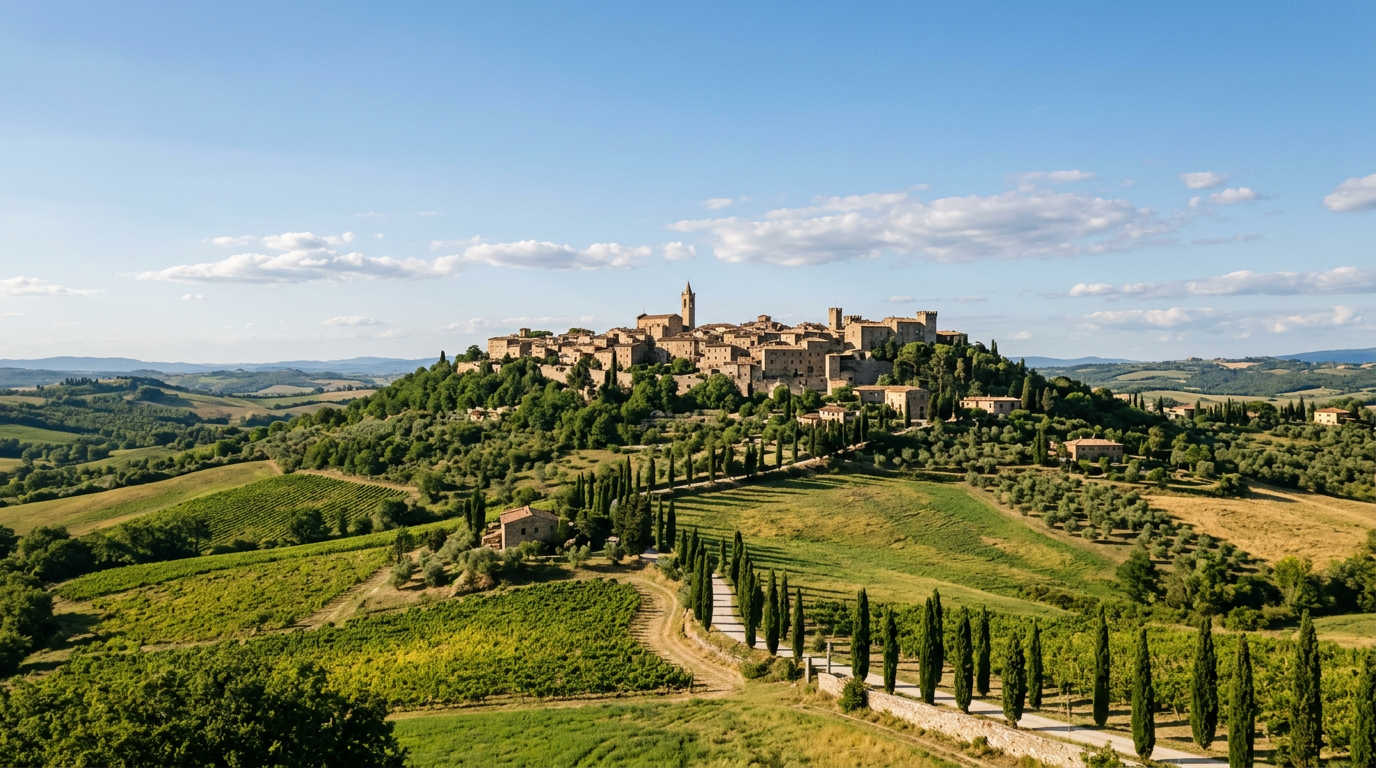
Casole d'Elsa: visiting a quiet medieval hilltop with exceptional sculpture
Casole d’Elsa sits at 417 metres on a hilltop at the southern end of the Val d’Elsa, 35 kilometres from Barberino Val d’Elsa and about 35 minutes by car. The village has a population of just over 3,000 and the kind of quietness that comes from being genuinely off the main tourist circuits. It is small, coherent, and rewarding in proportion to the attention you give it.
The view from the walls of Casole d’Elsa is among the most expansive in the valley. To the north the Val d’Elsa opens toward Colle Val d’Elsa and, on clear days, you can pick out the towers of San Gimignano about 20 kilometres away. To the south the hills begin to take on the character of the Crete Senesi, more sparsely vegetated, broader in scale, and distinctly different from the organised agricultural landscape of the Elsa valley proper.
Casole d’Elsa: medieval village
The settlement at Casole has roots going back to the Roman period, but the village that survives today is essentially a product of the thirteenth and fourteenth centuries. During that period the Sienese Republic asserted control over the southern Val d’Elsa, and Casole d’Elsa functioned as a fortified point in the Sienese defensive system, positioned to observe and control movement through the valley.
The historic centre retains most of its medieval urban structure. The main buildings — the Collegiate Church, the Palazzo Pretorio, and the circuit of walls — are all concentrated in the highest part of the ridge. The streets between them are narrow and largely free of modern intrusion. Walking the centre gives a reasonable sense of how a small Sienese hill town looked and functioned in the late medieval period.
The landscape visible from the walls has changed less in broad character than in most parts of Tuscany. The large estates to the south and east, many of which have been converted into agriturismo properties, continue the pattern of mixed agriculture and woodland that has defined this territory since the medieval period. The scale is open and the views are long.
A visit to Casole works best combined with a stop at Colle Val d’Elsa, about 12 kilometres to the north on the road back toward Barberino. Colle is a more substantial town with a medieval upper city that contains significant art and architecture, and the two stops together make for a full and varied day in the southern Val d’Elsa.
The Collegiate Church and its sculptures
The Collegiata dei Santi Maria Assunta e Marziale is the principal building of Casole d’Elsa. Founded in the eleventh century and rebuilt in the thirteenth and fourteenth centuries, the church has a stone facade of austere simplicity that fits naturally into the hilltop setting.
Inside, the most important works are two funerary monuments carved by Gano di Fazio, a Sienese sculptor active in the early fourteenth century. The tomb of Porrina di Bonifacio, who died in 1303, and the tomb of Ranieri del Porrina, who died in 1316, are both housed in the nave. These are not minor commemorative pieces: they are full sculptural programs with life-size recumbent figures on raised slabs, surrounded by carved architectural canopies and relief scenes from the lives of the deceased.
The quality of the carving is high. The face of Ranieri del Porrina in particular has a specificity of expression — the slight frown, the modelling of the eyelids, the treatment of the beard — that goes beyond convention and suggests the sculptor was working from observation as much as from formula. This quality of individual characterisation anticipates the direction Renaissance portrait sculpture would take a century later.
The church also preserves a carved stone altar from the fourteenth century and several other medieval furnishings that have not been significantly modified or removed. The overall impression is of an interior that has been cared for rather than curated: things are where they have always been, at the scale they were made for.
Opening hours are typically 9:00 to 12:30 and 15:00 to 18:00. Entry is free.
Civic and Diocesan Museum
The Museo Civico e Diocesano d’Arte Sacra is installed in rooms of the Palazzo del Podestà, the civic building adjacent to the Collegiate Church. The collection is focused and small: a selection of the most important works from the Collegiate and from other churches in the territory of Casole d’Elsa.
The most significant work in the collection is a Madonna and Child attributed to Duccio di Buoninsegna or to artists working directly in his circle. The painting is a small panel on gold ground with the tenderness of relationship between mother and child that is characteristic of the best Sienese painting of the late thirteenth century. Duccio, who died around 1318, was the founding figure of the Sienese school of painting and the immediate predecessor of Simone Martini and the Lorenzetti brothers. A work attributed to him or his immediate circle in a village museum of this size is an unusual find.
The collection also includes detached fresco fragments from local churches, carved wooden furniture from the fifteenth and sixteenth centuries, and devotional objects in silver and gilded copper from the same period. The display is modest in scale but the quality of the individual pieces justifies careful attention.
Entrance costs approximately four euros. The museum is open on weekends and on some weekdays, with hours that vary by season. Confirm current opening times before your visit.
The Val d’Elsa landscape to the south
Standing at the walls of Casole d’Elsa, particularly on the southern side, you can see where the Val d’Elsa ends and the Sienese countryside begins. The transition is not dramatic but it is real. To the north the valley is organised: rows of vines, olive groves, farmhouses placed in relation to field patterns and access roads, the whole landscape expressing centuries of intensive agricultural management. To the south the scale opens and the land becomes less densely worked, the hills rounder and paler, the settlements fewer and further apart.
This view south gives a useful sense of the geographic position of the Val d’Elsa. Barberino Val d’Elsa and the Chianti to the north are connected to the Florentine orbit: their agricultural history, wine culture, and architecture all point north. Casole d’Elsa is already at the edge of the Sienese world, looking toward Radicondoli and the territory that was contested ground between the two cities for centuries.
The road west from Casole d’Elsa leads to Monteriggioni in about 25 minutes and to Siena in about 40 minutes. The road south leads into increasingly underpopulated territory, which is worth exploring if you have a full day and no fixed schedule.
How to get there from Barberino Val d’Elsa
Casole d’Elsa is approximately 35 kilometres from Barberino Val d’Elsa. The drive takes around 35 minutes.
The most direct route follows the SR2 south from Barberino through Poggibonsi. After Poggibonsi, take the SP68 or similar roads west toward Colle Val d’Elsa and then continue south on smaller roads to Casole d’Elsa. An alternative and slightly more scenic route follows the SP1 south from Barberino to Colle Val d’Elsa before heading south on the SP541.
Public transport connections to Casole d’Elsa are very limited. The car is the only practical option for a day trip from Barberino.
Parking is available in free car parks outside the historic centre at the lower entrance to the village. The walk up to the Collegiate Church from the lower parking takes about ten minutes.
Where to stay
Sogno d’Oro guesthouse is situated near Barberino Val d’Elsa in the Val d’Elsa countryside. Casole d’Elsa is 35 minutes south, making it an easy half-day destination from the guesthouse. Combining it with a stop at Colle Val d’Elsa on the return journey gives you a satisfying day in the quieter, less visited southern part of the valley, with medieval art and landscape as the reward for the modest drive.