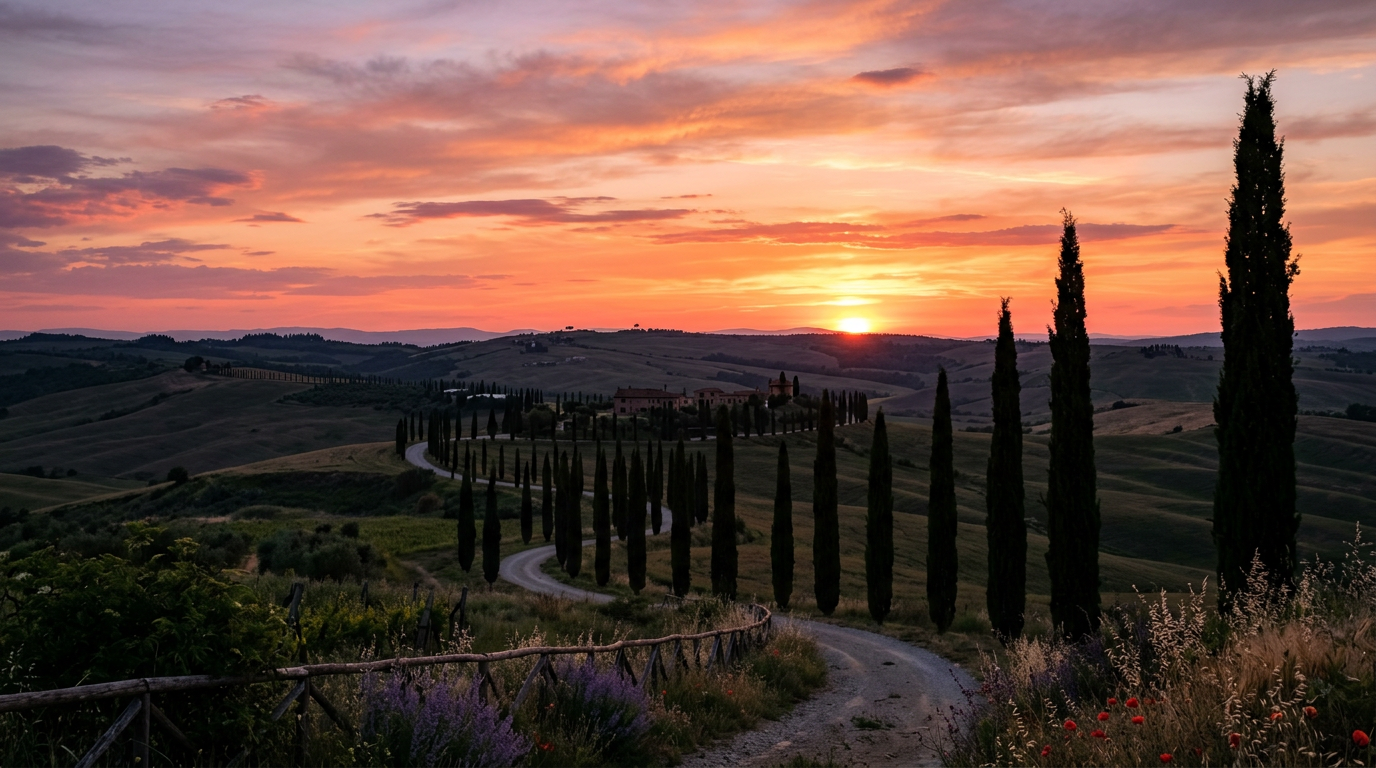
Tuscany sunset: where to watch the light change in the Val d'Elsa and Chianti
The quality of light in Tuscany in late afternoon is one of the things people describe years after a visit. It has something to do with the low angle, something to do with the warm dust particles suspended in summer air, and something to do with the pale limestone that reflects and diffuses rather than absorbs the colour. Whatever the physics, the result is that the hour before sunset in this part of central Italy produces a quality of natural light that is genuinely distinctive.
From Barberino Val d’Elsa you have access, within a 15-minute drive in almost any direction, to hilltop viewpoints, open ridge roads, and Romanesque churches standing alone in farmland that are all well positioned for watching the sun drop behind the western hills. None of them are on the tourist map. All of them are better for it.
The best sunset spots in Tuscany
Tuscany is large enough that sunset character varies considerably by zone. The famous viewpoints in the Val d’Orcia — the cypress lanes near Monticchiello, the hill above San Quirico, the ridge road between Pienza and Montepulciano — are extraordinary and genuinely worth visiting. But they are also crowded. At the most celebrated spots, cars park for several hundred metres along the verge and the actual viewpoint fills with tripods and phone screens long before the sun reaches the horizon.
The Val d’Elsa and Chianti hills around Barberino offer sunset quality that is equivalent in most conditions, with none of the congestion. The landscape elements are different: less theatrical in the way the Val d’Orcia is theatrical, more intimate, more varied. You have the choice between wide vineyard panoramas from ridge roads, enclosed views through cypress and oak woodland on country lanes, and long open perspectives from hilltop village walls.
The western exposure is the key variable. Villages and roads that face west across the Val d’Elsa toward the Apennines and the coast catch the full colour sequence from gold to orange to violet in clear weather. In hazy summer conditions the colours are more diffuse and often more saturated.
Val d’Elsa hills at sunset
San Donato in Poggio, about eight kilometres southeast of Barberino, is a small walled medieval village at around 350 metres elevation. The external walls on the western side have a terrace area that faces directly west across the Val d’Elsa toward the distant hill profiles. Arrive 30 minutes before sunset and find a position on the wall. The view covers vineyard-covered slopes in the foreground, the valley floor in the middle distance, and a clean horizon beyond. There is a bar in the village where you can have a coffee before and a glass of wine after.
Certaldo Alto, the medieval upper town of Certaldo about 12 kilometres north of Barberino, sits on a brick-built citadel at around 130 metres above the valley floor. The town has a long western terrace from which you can watch the sun set over the Arno plain and, in clear conditions, the hills toward the Tyrrhenian coast. The brick of the buildings takes on a particularly warm colour in the last 20 minutes of sunlight. Certaldo Alto has several restaurants where you can book dinner and spend the full evening in the upper town.
The Pieve di Sant’Appiano is a Romanesque church standing alone in farmland about three kilometres from Barberino on a minor country road. The church dates from the eleventh century and the surrounding landscape — fields, olive groves, a few scattered farmhouses — has been managed without major change for centuries. There is no formal viewpoint here and no infrastructure. You park on the roadside, walk into the field, and find a position with a clear western horizon. This is one of the quieter and more personal sunset experiences in the area.
Scenic roads near Barberino
The roads around Barberino Val d’Elsa and the southern Chianti are often as rewarding to drive at sunset as any fixed viewpoint. The movement through changing light, the vineyard rows catching the sun at different angles, the cypress shadows stretching long across the road surface: these are things that a photograph from a single point cannot fully convey.
The road from Barberino toward San Donato in Poggio via Sambuca passes through classic Chianti landscape. The final section before the village, lined with cypress trees on both sides and bordered by old vineyard walls, produces some of the most recognisably Tuscan images available in the area. Drive it slowly in the late afternoon.
The Chiantigiana, the SS222 state road connecting Florence and Siena through the heart of Chianti, is the most celebrated scenic drive in the zone. The stretch from Greve in Chianti south toward Panzano is particularly beautiful. In the afternoon, heading south, you drive directly toward the setting sun through open vineyard country. Panzano in Chianti itself, sitting on a saddle between two valleys, has a panoramic terrace in the upper village that faces west.
The secondary road from Barberino southward through Marcialla passes through working farmland with a good western exposure and almost no tourist traffic. On a clear evening the light on the fields here is as good as anywhere in the area.
How to photograph the sunset
The golden hour in Tuscany typically lasts 30 to 45 minutes before the sun reaches the horizon. Use this period for wide landscape shots that capture the three-dimensional quality of the hills and the vineyard patterns. The light is directional and warm, ideal for rendering depth through shadow.
The period immediately after the sun drops below the horizon — blue hour — is often better than the golden hour for photographing silhouettes, particularly the cypress profiles that define the Tuscan landscape. The sky deepens to a rich blue-violet and the trees, walls, and village towers become graphic shapes against it. This lasts about 20 minutes.
A tripod becomes increasingly useful as the light levels drop through blue hour into dusk. Without one, keep the ISO high and accept some grain rather than losing sharpness to camera movement. Phone camera night modes tend to over-process this kind of image: the tonal range they average out is precisely the quality of light that makes the scene interesting.
Shoot in the direction away from the sun during golden hour as well as toward it. The warm light falling on a vineyard or stone wall from behind you is often as beautiful as the direct view of the sun, and gives you a completely different colour palette to work with.
The less-known viewpoints
The most-photographed viewpoints in the Val d’Orcia and the Chianti are discovered by most visitors within the first day of arriving in Tuscany. There is nothing wrong with this — the famous views are famous because they are genuinely extraordinary — but if you prefer to watch a sunset without sharing the moment with a dozen strangers in a competitive tripod arrangement, the Val d’Elsa offers better options.
The ridge road east of Barberino Val d’Elsa toward Poggibonsi runs at around 350 metres. Parts of this road have clear western views across the valley. It is a working road with no particular designation as a viewpoint, which means you can stop on the verge and have the view to yourself.
The plateau above Tavarnelle Val di Pesa, eight kilometres from Barberino, has farm tracks along the ridge with wide westward panoramas at modest elevation. The setting is less dramatic than the hilltop villages but the solitude is more complete.
The area between Barberino and the Pieve di San Appiano has several access tracks leading to elevated points in the farmland from which the western view is clear and unobstructed. None are marked or named. Explore them by driving slowly and stopping when the horizon opens up.
Where to stay
Sogno d’Oro guesthouse is positioned near Barberino Val d’Elsa in a part of the Val d’Elsa where the quality of the late afternoon light is as good as anything the region offers. The surrounding landscape — vineyard slopes, old farmland, cypress lines — is the subject matter of the view.
A stay in spring, early summer, or autumn gives you the best light conditions and the least competition for viewpoints. These are also the seasons when the agricultural landscape is most varied in colour and texture, which adds further interest to a sunset drive.