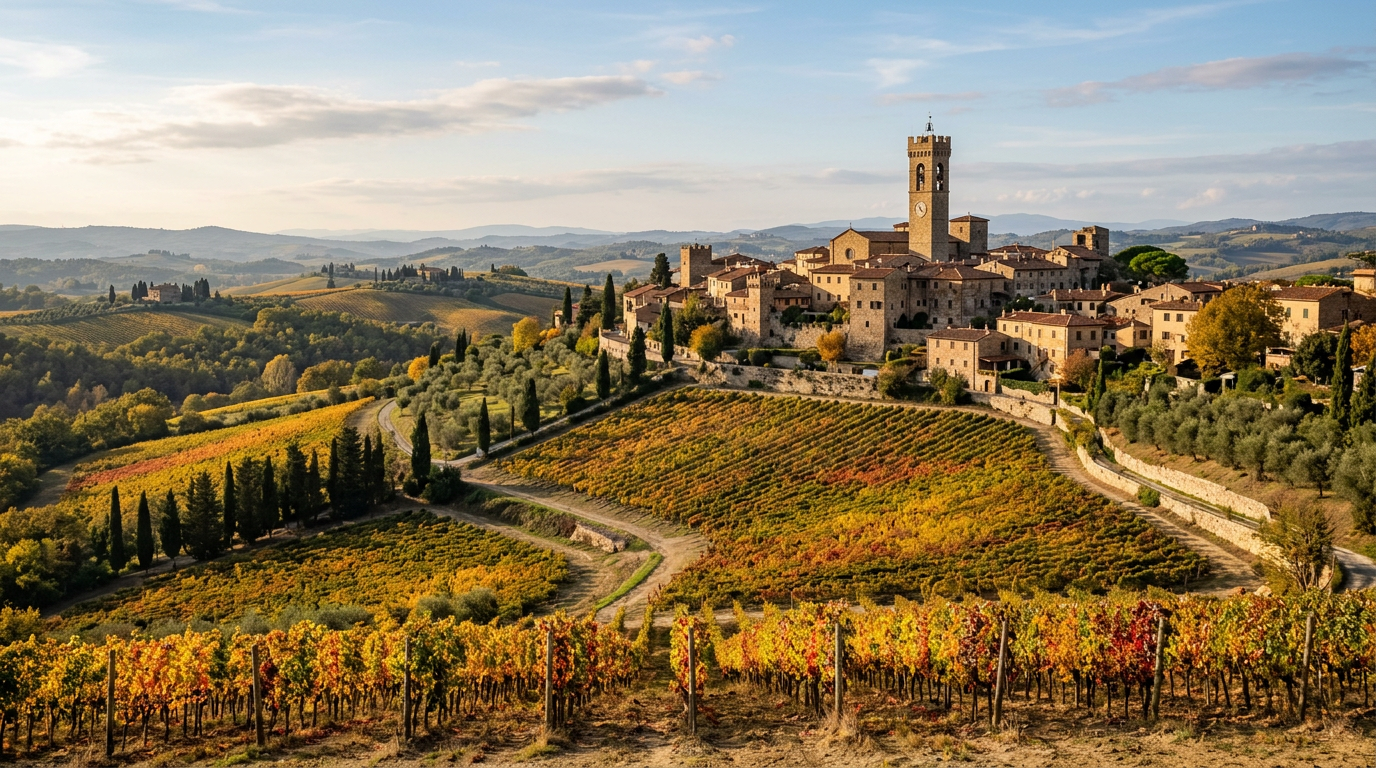
San Casciano Val di Pesa: medieval walls, a Simone Martini crucifix, and Chianti wine
San Casciano Val di Pesa is 15 kilometres from Barberino Val d’Elsa and about 18 minutes north by car. The town has a population of around 17,000 and sits on a ridge between the Pesa and Greve river valleys, with views across classic northern Chianti countryside on both sides. The hills here are planted with Sangiovese vines, marked by cypress trees, and dotted with stone farmhouses that have looked broadly similar for several centuries.
San Casciano is not a showpiece. It is a functioning town with its own economy, its own market day, and a population that uses the historic centre for daily life rather than tourism. This makes it a particularly honest destination: what you see is what exists.
San Casciano Val di Pesa: what to see
The historic centre occupies the ridge top within the mostly intact medieval walls. Via Roma, the main street, runs through the town from the Porta Fiorentina at the north to the Porta Senese at the south. Walking the full length takes about 15 minutes at a relaxed pace. The buildings along it mix medieval foundations with later modifications, the kind of layered urban fabric that develops over seven or eight centuries of continuous occupation.
San Casciano came under Florentine control in the early fourteenth century and the town walls date primarily from the Florentine period. Three of the medieval towers survive in recognisable form. The Porta Senese at the southern end of the main street is the best preserved gate: a pointed arch in local stone, flanked by towers, photogenic in late afternoon light when the shadows sharpen.
The weekly market on Thursday mornings fills Piazza della Repubblica with stalls selling fresh produce, local cheese, seasonal vegetables, and household goods. The square itself, with a fountain at its centre and buildings of different periods arranged around it, is a good place to spend 20 minutes watching the town go about its business.
Historic centre and walls
The most historically interesting building outside the two main museums is the area around the medieval walls themselves. Walking the outer perimeter of the walls takes about 20 minutes and provides a sequence of views over the Pesa valley to the west and the Chianti hills to the east.
The Torre dei Portici and the Torre del Trecento are the two most visible surviving medieval towers. A third is incorporated into a private building along the via Roma. The defensive logic of the ridge site is clear from a walk along the walls: the town controlled a high point between two river systems and could observe movement in the valley below on both sides.
The Church of Santa Maria del Gesù, on Via Machiavelli just inside the historic centre, has a fourteenth-century facade and an interior with works from the same period. The street name is not coincidental: Niccolò Machiavelli, the Florentine political philosopher and author of The Prince, owned a farm at Sant’Andrea in Percussina, about five kilometres north of San Casciano. The property, known as the Albergaccio, is where he wrote The Prince during his period of political exile from Florence after 1512. The house can be visited.
Sacred Art Museum
The Museo di Arte Sacra di San Casciano Val di Pesa is housed in the convent buildings adjacent to the Church of Santa Maria del Gesù. The collection brings together works from churches in the town and the surrounding territory, spanning roughly the thirteenth to the seventeenth century.
The quality of several pieces is genuinely exceptional. The most important is a painted Crucifix by Simone Martini, created around 1315 to 1320. Simone Martini was one of the leading painters of the Sienese school, known for the elegance of his line, the precision of his gilding, and the expressive depth of his figures. The San Casciano Crucifix is a major work by a major artist and is one of the very few panel paintings by him outside important city museums. Spending time in front of it in an uncrowded gallery is an experience that visitors to Siena and Assisi, where his other major works are installed, cannot always have.
The collection also includes works attributed to Ambrogio Lorenzetti and paintings by Florentine and Sienese masters of the fourteenth and early fifteenth centuries. Several pieces show the dialogue between the Florentine and Sienese schools that characterised the art of this border territory.
Entrance costs around five euros. Hours are Tuesday to Sunday, 10:00 to 13:00 and 15:00 to 19:00. The museum is closed on Mondays. The staff are usually available to explain specific works in detail if you ask.
Nearby Chianti Classico wineries
San Casciano Val di Pesa is at the northern end of the Chianti Classico denomination. The wines produced in this northern zone tend to be slightly more aromatic and lighter in structure than those from the warmer southern part of the area near Gaiole in Chianti. The terroir here — higher altitude, slightly cooler nights, soils with more clay content — produces Sangiovese with pronounced floral character and fresh acidity.
Antinori nel Chianti Classico, the architecturally striking underground winery near Bargino, is about eight kilometres southeast of San Casciano. It is one of the most visited wine destinations in the Chianti and requires advance booking for tours and tastings, which start at around 35 euros per person.
Castello di Gabbiano, about five kilometres south of San Casciano along the road toward Greve, occupies a medieval castle with extensive surrounding vineyards. Tastings are available and tours of the castle can be arranged. The Chianti Classico wines produced here are consistent and fairly priced.
Villa Cerna, owned by the Cecchi family and about four kilometres from San Casciano on the road to Greve, produces reliable Chianti Classico and a range of IGT wines. Visits by appointment.
For informal tasting without a reservation, the Enoteca del Chianti in the San Casciano town centre offers wines by the glass from local producers at accessible prices. It is a good way to understand the range of styles across the northern Chianti territory before choosing which estates to visit.
How to get there from Barberino Val d’Elsa
San Casciano Val di Pesa is approximately 15 kilometres from Barberino Val d’Elsa. By car the drive takes around 18 minutes. The most direct route follows the SP20 north from Barberino toward Tavarnelle Val di Pesa and then continues on the SP1 north toward San Casciano. The road passes through the heart of the Chianti Classico countryside and is pleasant to drive at any time of year.
Public transport from Barberino Val d’Elsa to San Casciano is not practical for a day trip. Bus connections from San Casciano to Florence are frequent on the Busitalia network, making San Casciano accessible from the city if you prefer to travel that way.
Parking outside the Porta Senese is the most convenient option. The car parks near the southern gate are generally free.
Where to stay
Sogno d’Oro guesthouse is positioned near Barberino Val d’Elsa, 15 kilometres south of San Casciano. The short distance makes San Casciano a natural destination for a half-day combining the Sacred Art Museum with a winery visit and lunch. You can be back at the guesthouse in the early afternoon with the rest of the day to explore the Val d’Elsa countryside or simply rest.