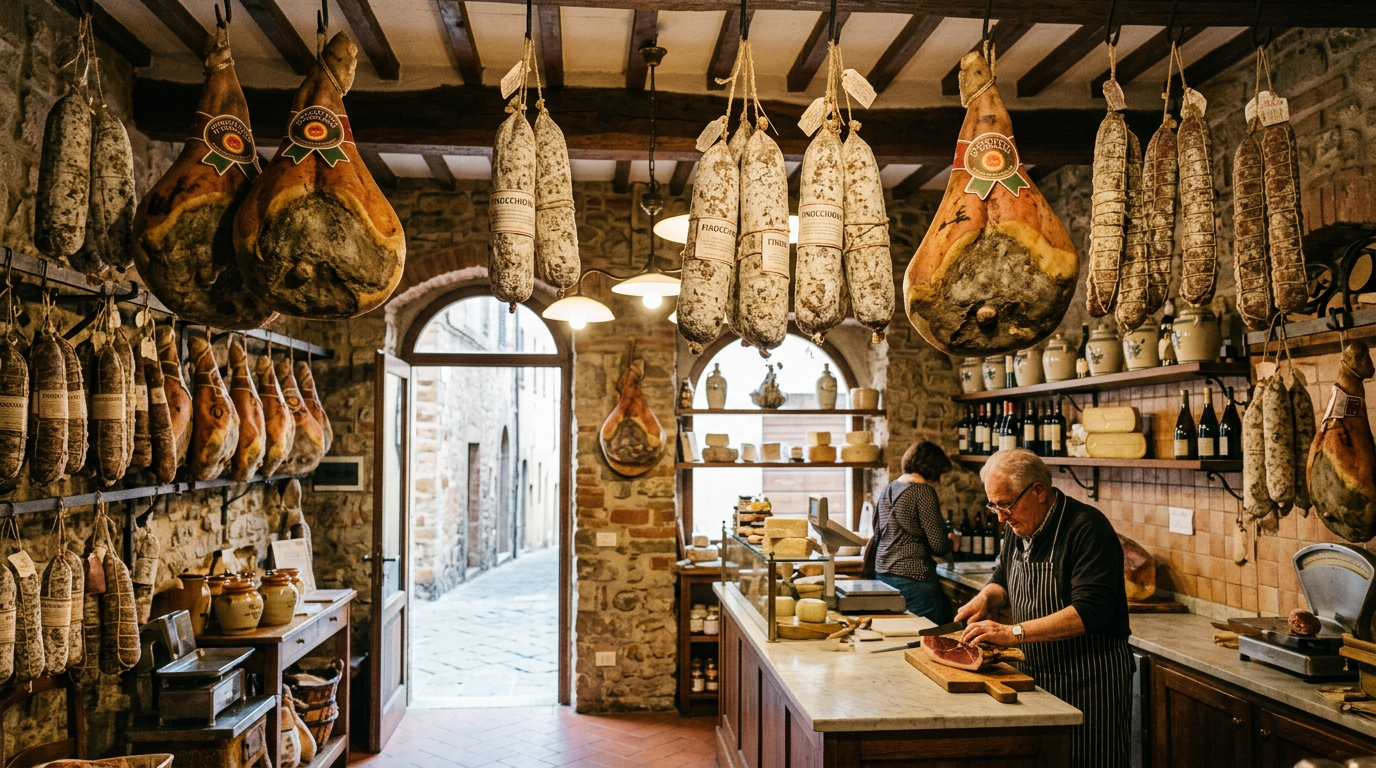
Tuscan cured meats: where to buy the best near Barberino Val d'Elsa
Tuscan salumi occupy a distinct position in Italy’s broad landscape of cured meats. They are saltier than those from Emilia-Romagna, more herb-forward than most from Veneto, and often made with heritage pig breeds that produce richer, more marbled meat than modern commercial varieties. The flavours are direct and sometimes startling to palates used to sweeter products. Paired with the region’s famously unsalted bread and a glass of Chianti Classico, they make a kind of sense that has nothing to do with modern food fashions.
Around Barberino Val d’Elsa you have access to some genuinely excellent artisan production. This is not a tourist product here. Cured meat is a daily food, made and sold by people who take it seriously and buy it from people who do the same.
Tuscan cured meats: where to buy them
The best places to buy Tuscan salumi near Barberino Val d’Elsa are local butchers (macellerie), specialist alimentari, and farm shops with their own production. These shops do not advertise with tourist signs. They open early, close at lunchtime, and reopen in the afternoon for local customers. The rhythm is the rhythm of the working day, not the tourist itinerary.
In Barberino Val d’Elsa, the local alimentari and butchers carry sliced finocchiona, prosciutto toscano, sbriciolona, and lardo in forms and quantities that reflect local consumption. Supplies change based on what has been produced recently and what local customers have already taken. Coming in the morning generally means a fuller counter.
Certaldo, about 12 kilometres north of Barberino, has a respected butcher in the lower town that serves the surrounding area. This shop makes its own versions of several Tuscan salumi in house and can cut to your specifications. It is not a tourist shop. Expect to take a number and wait alongside local customers doing their weekly shop.
Colle di Val d’Elsa, about 15 kilometres south, has a selection of alimentari in its historic upper town that carry products from small producers who do not operate their own retail spaces. This is useful for finding things that are locally made but not widely distributed.
Siena offers the widest selection in a single location. The covered market near the Piazza del Mercato carries products from producers across the province. If you want to compare several versions of the same product side by side, a morning in the Siena market is the most efficient approach. The drive from Barberino takes about 35 minutes.
Finocchiona and Tuscan ham
Finocchiona is the most immediately recognisable of the Tuscan salumi. It is a large, soft sausage made from pork with wild fennel seeds, garlic, and black pepper. The name comes from finocchio, the Italian word for fennel. The result is aromatic and slightly fatty, with a texture that varies by producer from relatively firm to almost spreadable, a version called sbriciolona.
The IGP-protected finocchiona uses defined cuts and specific production methods. Artisan versions made by small butchers follow similar traditions but with more freedom in the seasoning balance. A well-made finocchiona sliced thin, at room temperature, on a thick slice of Tuscan unsalted bread is one of the most honest and satisfying expressions of local food culture.
Prosciutto toscano DOP is a substantially different product from the more internationally famous prosciuttos of Parma and San Daniele. Where those hams aim for sweetness and delicacy, prosciutto toscano is cured with sea salt, black pepper, rosemary, garlic, and juniper. The leg is rubbed by hand at intervals over a minimum of 12 months. The resulting ham is firmer, saltier, and more intensely flavoured. It is not a product for those who prefer a mild ham. It is a product for those who want the full, uncompromised character of Tuscan pig.
Sbriciolona is a softer cousin of finocchiona, made from pork shoulder, belly, and pancetta with wild fennel. The mix is less compact than finocchiona and the texture crumbles when sliced, which is the origin of the name (sbriciolona means something that falls apart). Buy it in small quantities and eat it the same day.
Lardo di Colonnata is the most luxurious preparation in the Tuscan cured meat repertoire. Pure pork back fat, cured in marble basins in the quarry town of Colonnata in the Apuan Alps with rosemary, garlic, and a specific blend of spices and herbs, it is eaten in thin translucent slices over warm bread. The flavour is clean, sweet, and deeply unctuous. Not every alimentari in the Val d’Elsa carries it. Ask specifically, and expect to pay more than for the other products.
Local butchers and delicatessens
A good Tuscan macelleria is a community institution with a social function that extends well beyond meat selling. The butcher often knows the farms that supplied the animals. Many make their own salumi in the back room. The counter conversation is part of the transaction.
When you enter a traditional macelleria or alimentari, take a number from the dispenser and wait your turn. Do not try to catch the attention of the counter staff out of sequence. When you reach the counter, ask questions. Ask where the product came from, how long it was aged, whether it is their own production. A good shop welcomes these questions. It demonstrates that you are a serious buyer rather than a casual one.
Ask to taste before buying. This is completely standard practice in a quality shop and will not be treated as unusual. Most good alimentari will offer a small sample of the product you are considering, especially if you show genuine interest.
Buy in smaller quantities from several shops rather than a large amount from one. The variety of Tuscan salumi from different producers is interesting, and understanding the differences between a finocchiona made in Certaldo and one made in Barberino gives you a more complete picture of local food culture.
Vacuum packing is available on request at most alimentari. It extends shelf life by several weeks and makes transport home much easier. The vacuum-packed product will be slightly different from freshly sliced, but the quality of a good artisan product survives the process well.
Markets and local fairs
Weekly markets in the Val d’Elsa reliably include stalls selling sliced salumi and whole pieces. These market vendors range from excellent small producers selling direct to intermediaries who source from a mix of artisan and industrial operations. The difference is usually visible in the product and the price.
The weekly market in Barberino Val d’Elsa is a starting point. The Thursday market in Poggibonsi has a solid food section. The Friday market in Colle di Val d’Elsa and the Saturday market in Certaldo are both worth attending if your stay overlaps with their days.
Autumn sagre, local festivals often celebrating a specific product or historical event, sometimes feature producers using heritage pig breeds. The Cinta Senese is the native Tuscan pig breed: black with a white band across the shoulders, slower-growing and more expensive to raise than commercial breeds, but producing meat with substantially more flavour and marbling. Salumi made from Cinta Senese carry a noticeably higher price tag. The difference in flavour justifies it.
How to recognise quality artisan cured meats
Several reliable signs distinguish quality artisan products from industrial ones.
Traceability is the first signal. A shop or producer who can tell you the farm, the breed of pig, and the approximate month of production is selling something real. Generic labelling with only the curing facility tells you almost nothing.
The appearance of finocchiona at a cut surface should show a deep pinkish-red colour with clearly visible pockets and marbling of white fat. Fat that is evenly distributed in a pale pink matrix suggests heavily processed meat from an industrial operation.
For prosciutto, ask specifically about the ageing time. The minimum for prosciutto toscano DOP is 12 months. Artisan producers often age for 18 or 24 months. Longer ageing means a more concentrated and complex flavour. The fat at the edge of a well-aged prosciutto should be white to very pale cream and should smell sweet and clean.
Price tells you something. A kilogram of quality finocchiona from an artisan producer costs 15 to 20 euros. Seeing the same product priced at six or seven euros almost always indicates industrial production, regardless of what the label says.
Where to stay
Sogno d’Oro in Barberino Val d’Elsa puts you at the centre of the Val d’Elsa food world. The local butchers, the weekly markets, and the farm shops that sell genuine artisan cured meats are within easy reach.
Spend a morning exploring the food landscape of the area and return with a selection that tells the story of where you have been more accurately than any postcard.