Monticchiello complete guide: walls, theatre, food, and day trip tips
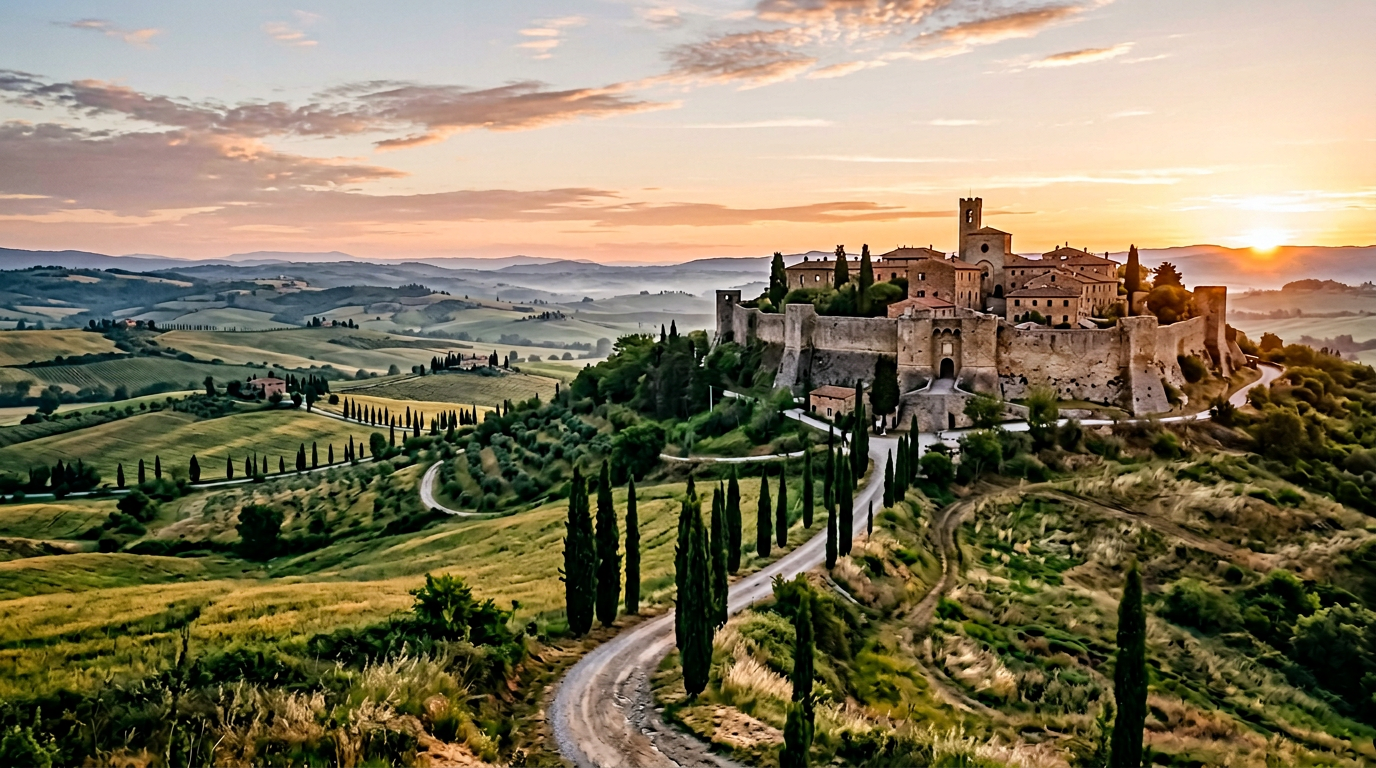
Monticchiello sits at the southern edge of the Val d’Orcia on a ridge at 520 metres. It is a walled village of about two hundred permanent residents, an intact medieval circuit, and a community theatre tradition that has no equivalent anywhere else in Italy. The landscape visible from its northern wall is among the most celebrated in the world: a UNESCO panorama of cypress rows, clay hills, and open sky that stretches from Pienza in the north to Monte Amiata in the south.
The distance from Barberino Val d’Elsa is approximately 70 km. The drive takes about 60 minutes on roads that pass through Siena, then east into the Val d’Orcia toward Pienza. It is one of the most rewarding day trips available from a Chianti base, and it deserves a full day rather than a rushed afternoon.
Monticchiello: the complete guide
Monticchiello rewards visitors who do not hurry. The village is compact enough to walk entirely in half an hour, but its layers of history, its theatre tradition, and the quality of its light reward a slower pace. Spend a morning walking the walls and the internal lanes, stop for lunch at the osteria, and then give the afternoon to the viewpoint as the sun drops in the west. This is the full experience.
What makes Monticchiello distinct from other beautiful medieval villages in Tuscany is its insistence on remaining a living community. The Teatro Povero project, which has run every summer for more than fifty years, is the strongest expression of this. The village talks about itself and to itself through theatre, and the result is a place with a self-awareness that is completely different from a preserved monument.
The physical beauty of the place is undeniable. Stone, cypress, pale hills, and silence. But it is the combination of that beauty with an active intellectual and cultural life that gives Monticchiello its particular character.
The history of the village
The earliest documented references to Monticchiello date from the 9th century. Its elevated position on the ridge between the Val d’Orcia to the west and the Chiana valley to the east gave it strategic value, and it changed hands several times between rival powers through the medieval period before passing definitively under Sienese control in the 14th century.
The circuit of walls that survives today was built primarily in the 13th and 14th centuries and reinforced in subsequent periods. It is unusually complete. The towers, the main gate, and long stretches of curtain wall are all intact and give the village a martial silhouette visible from several kilometres away on the approach road from Pienza.
Inside the walls the village has changed slowly. When Siena fell to the Florentines in 1555, the Val d’Orcia entered a long period of economic marginalisation under Medici and then Habsburg-Lorraine governance. This marginalisation, paradoxically, preserved the built fabric that wealthier communities might have demolished and rebuilt. The poverty that limited the villages of the Val d’Orcia for centuries is the same poverty responsible for the extraordinary preservation we benefit from today.
The church of Santi Leonardo e Cristoforo, at the highest point of the village, dates from the medieval period and was modified in later centuries. Inside, a fresco panel has been attributed to Pietro Lorenzetti, a Sienese artist of the early 14th century known for his use of spatial depth and naturalistic expression. The attribution remains debated, but the quality of the painting is not. It is devotional art of real sensitivity, created for a small and remote community far from the major commissions of Siena or Florence.
Depopulation in the 20th century reduced the resident population from several hundred to around two hundred. Those who remained developed a strong collective identity, expressed most clearly through the theatre project founded in 1967.
Teatro Povero and its uniqueness
The Teatro Povero di Monticchiello is a collective theatre company entirely composed of village residents. It was founded in 1967 by a group of farmers and community members who wanted to make theatre about their own lives rather than perform existing texts. Every year since then, the community has gathered in winter and spring to develop a new original play, which is performed in the village square through July and early August.
The plays are written collectively through a process of discussion and revision that begins with a community-chosen theme. The themes change every year but consistently engage with the village’s own experience in an Italian society that has changed profoundly since the 1960s. Past productions have addressed the abandonment of agricultural traditions, the effects of external tourism on local identity, the experience of young people in a depopulating rural community, and the relationship between memory and the present.
The performances use the village square, the medieval walls, and the open Val d’Orcia landscape as a stage set. Seating faces outward toward the countryside. The effect of watching theatre in that setting, as the light changes on the hills during the performance, is one of the more unusual theatrical experiences available in Tuscany.
The actors are not professionals. A farmer who has played in the Teatro Povero for twenty years is performing alongside young people doing it for the first time. The mix gives the productions a specific quality that trained theatre companies cannot replicate.
Tickets are sold through the company’s official website and sell out well before the season opens. If you plan to attend, watch the website from June and act quickly when booking opens.
The walking path around the village
The perimeter path that follows the outer base of Monticchiello’s walls is about 1.5 kilometres and takes between 30 and 45 minutes at an easy pace. It begins at the car park below the Porta Nova and circles the village, passing under the tower sections and along stretches of open ground and light woodland.
From the western section of the path, looking out over the Orcia valley, the view extends toward Monte Amiata to the south and across the open farmland that defines this part of the UNESCO landscape. The vegetation along the base of the walls includes old olive trees and seasonal wildflowers in spring.
From the northern section, the path opens toward Pienza to the north-northwest. The distinctive outline of the town, with its cathedral apse and the palazzo of Pius II, is visible on clear days. The cypress-lined road approaching Pienza from the west is one of the most photographed stretches of Tuscan countryside and is visible from here without any obstruction.
The path is accessible for most fitness levels. The ground is mostly firm with a few uneven sections near the towers. Ordinary walking shoes are adequate in dry conditions. After rain the ground near the base of the walls can be slippery.
An extended walk continues from the walls down into the agricultural land below the village. Tracks follow the ridge south toward the Orcia valley. The extension adds anywhere from 45 minutes to two hours depending on how far you go and whether you stop to look at the landscape.
How to get there and where to eat
From Barberino Val d’Elsa, the route south follows the SR2 Cassia through Poggibonsi and Siena. After Siena continue south on the SR2 toward Buonconvento. At Torrenieri take the road east toward Montepulciano. Pass through Pienza, then follow the secondary road south for seven kilometres to Monticchiello. The total distance is approximately 70 km and the drive takes about 60 minutes.
On weekends and during the summer theatre season, the car park below the Porta Nova fills quickly. Arriving before nine in the morning or after six in the evening avoids the worst of the weekend crowds.
For food inside the village, Osteria La Porta is the reliable choice. The menu changes with the season and sources ingredients from local producers. Typical autumn and winter dishes include pici al ragù di cinghiale (pasta with wild boar sauce), ribollita, slow-roasted Cinta Senese pork, and in-house desserts made with seasonal fruit. Reservations are essential on weekends and throughout July and August. A small bar near the gate serves coffee and simple snacks for those who want something lighter.
The most pleasant way to eat in Monticchiello on a budget is to buy provisions in Pienza before arriving and eat at one of the stone tables near the northern viewpoint. Pienza pecorino, local prosciutto, and bread from the alimentari make a lunch that fits the setting perfectly.
Where to stay
Sogno d’Oro in Barberino Val d’Elsa is a 60-minute drive from Monticchiello. The location in the Chianti gives you central access to the full arc of Tuscan destinations, from the Chianti wine country immediately around the guesthouse to the Val d’Orcia and the Crete Senesi to the south.
A day trip to Monticchiello from Barberino is a natural pairing: morning in the Chianti, afternoon in the Val d’Orcia, evening back in the quiet of the guesthouse. The contrast between the two landscapes in a single day gives you a strong sense of how varied this part of Tuscany really is.