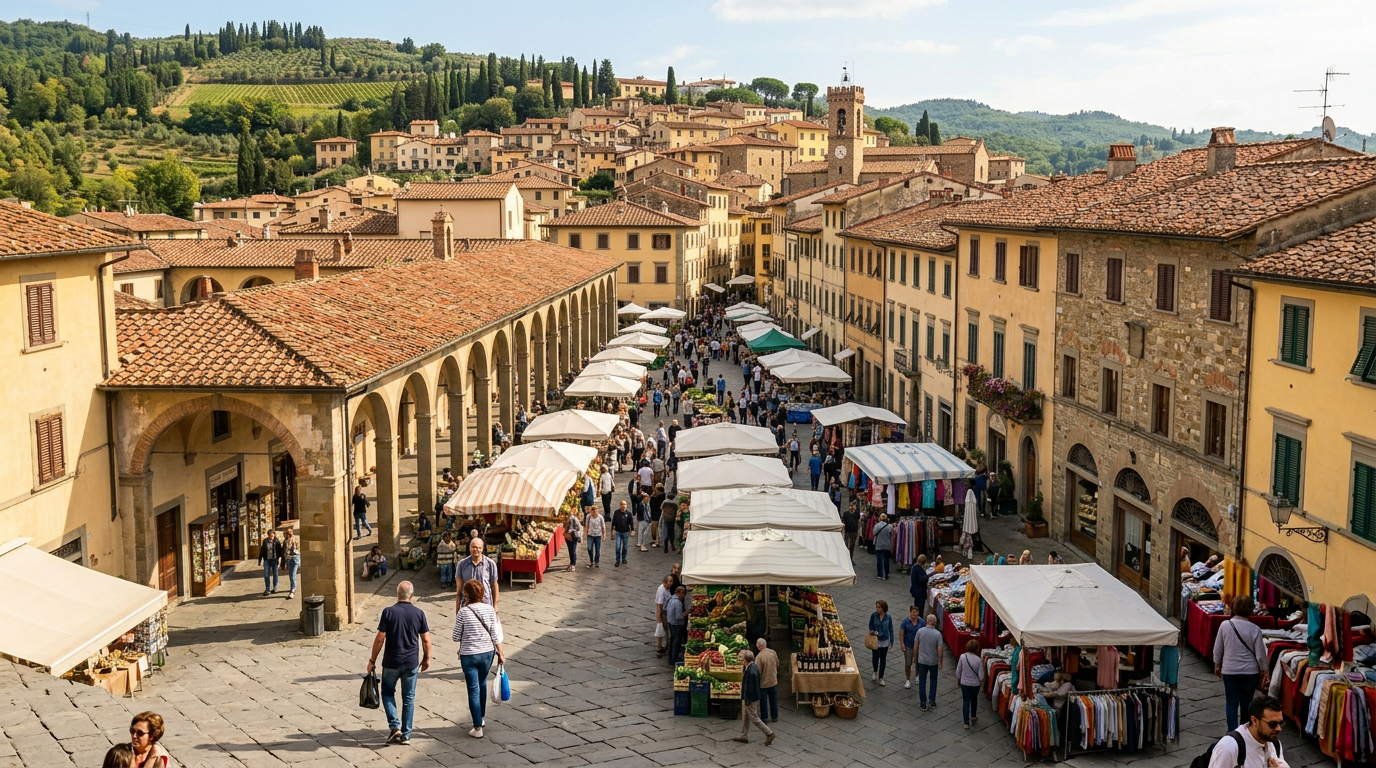
Greve in Chianti: wine capital of the Chianti Classico zone
Greve in Chianti is the largest and most commercially active town in the northern Chianti Classico zone. With a population of around 14,000, it operates as the administrative and commercial centre for the wine estates, villages, and rural communities spread across the hills on either side of the SR222. It is more town than village, with shops, banks, restaurants, and a weekly market that serves real residents rather than just visitors.
From Barberino Val d’Elsa, Greve is 22 km to the east and approximately 25 minutes by car. It is the natural base for Chianti Classico wine tourism, particularly for anyone who wants to taste and buy wines from multiple producers without driving between separate estates.
Greve in Chianti: what to see
Greve sits in the valley of the Greve river, at a point where several routes through the Chianti hills converge. That junction made it a natural market town for the wine estates of the surrounding territory from the medieval period onward. The commercial function has remained constant even as the surrounding agriculture shifted from mixed farming to the monoculture of viticulture. What changed is the scale and the audience. The market in Greve today serves wine tourists from across Europe as much as it serves the local farmers and producers.
The town is not primarily an architectural destination. Greve has no great cathedral, no significant palazzo, no medieval towers. Its appeal is different: the living wine culture concentrated in the main square and its surroundings, the accessibility of producers who are otherwise scattered across difficult terrain, and the atmosphere of a place where the local economy is built openly and proudly on what the vineyards produce.
For wine buying and tasting, Greve is one of the most efficient locations in all of Tuscany. The Enoteca del Chianti Classico stocks hundreds of bottles from the entire DOCG zone, with staff who know the producers and can advise on vintages and styles. Several independent wine bars and shops under the arcades of Piazza Matteotti offer tastings by the glass, allowing you to compare producers without committing to a full bottle.
The countryside around Greve is also excellent for cycling. The SR222 (the Via Chiantigiana) and the network of gravel roads through the vineyards connect Greve to the surrounding estates and villages. The terrain is hilly and demanding in places, but the scenery along every route is exceptional.
Piazza Matteotti with its arcades
Piazza Matteotti is the heart of Greve in Chianti and one of the most architecturally distinctive public spaces in the entire Chianti zone. Unlike the regular geometric piazzas of planned Italian towns, Piazza Matteotti is an irregular triangle that widens at one end and narrows to a point at the other. This irregular shape, accumulated over centuries of incremental construction, is part of what gives the square its character.
The buildings surrounding most of the square are arcaded on the ground floor. These logge were built to shelter the commercial activity — trading, market stalls, the buying and selling of wine and agricultural produce — that has been conducted in this square for centuries. Under the arches today you will find butchers, delicatessens, cheese shops, wine bars, and cafes. Some of these businesses have been operating in the same premises for generations.
At one end of the square stands a bronze statue of Giovanni da Verrazzano, the explorer born near Greve in 1485. Verrazzano sailed under the French flag and in 1524 became the first European to navigate the coast of what is now New York harbour and much of the North American eastern seaboard. The town commemorates this connection with evident pride and the statue is a handsome reminder that the Chianti countryside has produced explorers as well as winemakers.
The most animated time in the square is Saturday morning, when the weekly market fills the space with produce stalls, clothing, and local specialties. This is a genuine working market rather than a tourist market — the stalls reflect what is actually being grown and produced in the surrounding territory at that point in the season. In May, early summer vegetables. In September, mushrooms and truffles. In November, new olive oil and late harvest grapes.
Even on quieter days, the bars and cafes under the arcades offer outdoor seating that is pleasant in every season except the coldest days of January and February. A coffee at one of the piazza bars in the morning, watching the town begin its day, is a reliable way to understand the tempo of Chianti life.
The Mercatale di Greve
The Mercatale di Greve is the most important wine event in the Chianti Classico calendar. Held annually in late May, it occupies the main square and several surrounding areas for several days, during which dozens of Chianti Classico producers open their wines for public tasting, sell directly to visitors, and participate in seminars and guided sessions.
The Mercatale draws wine professionals, collectors, and enthusiasts from across Europe. The event is organised by the Chianti Classico Consortium and represents a genuine cross-section of the entire DOCG zone, from the smallest family estates to the most internationally recognised producers. Entry to the general tasting area costs around 20 to 25 euros and includes a tasting glass. This is exceptional value for the range of wines accessible in a single afternoon.
If you are visiting in late May, timing your trip to coincide with the Mercatale is worth planning for. It offers a concentrated introduction to the range of styles and producers within the zone that would otherwise require a series of separate winery visits.
Outside the fair period, the Enoteca del Chianti Classico in Piazza Matteotti provides a year-round version of the same comparative experience on a smaller scale. The selection spans the whole DOCG zone and includes bottles from estates that do not accept visitors independently. Staff can advise on the best current vintage and which producers are worth seeking out for a direct visit.
Wineries and wine bars
The area immediately around Greve in Chianti has a high concentration of significant Chianti Classico estates. Several of the most important names in the denomination are within 10 km of the town centre.
Fontodi occupies the Conca d’Oro, a natural amphitheatre of south-facing vineyards on the hill above Greve. The estate has practised biodynamic farming for many years and produces Chianti Classico Gran Selezione that consistently ranks among the finest in the zone. Visits are by appointment and cost around 30 euros. The winery is not informal about bookings, but the experience of tasting with a producer who is genuinely passionate about every aspect of the viticulture is worth the advance planning.
Vignamaggio, about 5 km from Greve on the road toward Panzano, is a historic Renaissance villa estate with a long oenological reputation. There is an unverified tradition — maintained with some enjoyment locally — that Leonardo da Vinci painted the model for the Mona Lisa here. Whether or not the story holds, the estate is beautiful and the wines are good. Visits and tastings are available by appointment.
Castello di Querceto, about 7 km from Greve, produces a wide range of Chianti Classico from a property in a genuine medieval castle. The range from basic Annata to single-vineyard selections covers most price points and styles. Accommodation is available on site.
For wine by the glass without leaving the town centre, Enoteca Falorni under the arcades of Piazza Matteotti is the most established option. The selection is wide, the service is knowledgeable, and prices start at around 5 euros per glass for standard Chianti Classico. For a more curated and quieter tasting experience, several smaller wine bars on the streets off the main square offer a focused selection with more personalised service.
How to get there from Barberino Val d’Elsa
Greve in Chianti is approximately 22 km from Barberino Val d’Elsa. By car the drive takes around 25 minutes.
The most direct route heads north from Barberino on the SP20 toward Tavarnelle Val di Pesa, then east on the SP92 into the Chianti hills, and finally north-east on the SR222 to Greve. The SR222, known as the Via Chiantigiana, is one of the classic Tuscan roads — it passes through the heart of the wine country, connecting Florence to the north with Greve, Panzano, Castellina, and Siena to the south. Taking this road from Barberino to Greve is longer in distance than the direct route but rewarding for the scenery and the vine-covered landscape on both sides.
Parking in Greve is available in the car park on Via Cesare Battisti, the most convenient for Piazza Matteotti, and in several other surface lots near the centre. Parking in the surface lots is generally free. Some zones closer to the square charge a nominal 1 to 1.50 euros per hour.
Where to stay
Sogno d’Oro is set in the Val d’Elsa near Barberino Val d’Elsa. Greve in Chianti is 22 km to the east, at the operational centre of the Chianti Classico wine zone. From this base the entire northern Chianti territory — Greve, Panzano, Radda, Castellina — lies within 30 minutes by car.
The wine country visible from the guesthouse and the wine country you drive into when you head east are part of the same landscape and the same agricultural tradition. The continuity between where you stay and what you explore is one of the satisfying qualities of the Val d’Elsa as a base.