Gaiole in Chianti: what to see, from Brolio to the best wineries
Gaiole in Chianti is the southernmost of the three main towns of the Chianti Classico zone. Its territory is the largest of the three — larger than Greve in Chianti, larger than Radda — and it contains some of the most historically and oenologically significant estates in all of Tuscany. Castello di Brolio, Badia a Coltibuono, Castello di Ama, and San Felice are all here.
From Barberino Val d’Elsa the distance is about 40 km and the drive takes roughly 40 minutes. That is slightly further than Radda or Castellina, but the added distance is justified by what awaits you: a castle that helped define Italian wine history, a medieval abbey producing one of the most consistent Chianti Classicos in the zone, and a landscape that grows more dramatic the further south you travel.
Gaiole in Chianti: what to see
Honesty first: the town of Gaiole itself is not the draw. Unlike Greve with its arcaded piazza or Radda with its intact medieval centre, Gaiole’s town centre is modest and somewhat functional. It was rebuilt after damage in the Second World War and retains little of the medieval character that defines the other Chianti towns.
But this misses the point of coming here. Gaiole is a base and a gateway. The landscape surrounding it — steeper, wilder, and more forested than the northern Chianti — is genuinely outstanding. The estates in this territory make wines with the structure and concentration that comes from altitude, mixed soils, and an orientation that favours slow, cool ripening.
There is a Thursday market in the town centre, a few restaurants, and a wine bar stocking bottles from local producers. For the best food experience in the Gaiole area, book a table at one of the estate restaurants rather than eating in the centre.
The Church of Santa Maria in Spaltenna, about 2 km east of Gaiole, is an 11th-century Romanesque church now incorporated into a hotel and restaurant complex. The interior is open to visitors and provides a quiet counterpoint to the busier estate visits.
The hamlet of Vertine, 5 km north of Gaiole, is one of the most completely preserved medieval villages in the Chianti. The walls are intact, the buildings inside are entirely original, and there are almost no other visitors. It is one of the best small places in the region and deserves at least an hour.
The village and its territory
The village of Gaiole in Chianti sits in a small valley between two ridges at about 360 metres above sea level. The population is approximately 2,800. The valley setting gives it a different quality from the hilltop towns — the light here arrives earlier and lingers differently.
The hills south of the town are among the most dramatic in the Chianti. The road toward San Polo in Rosso and beyond passes through dense oak forest and opens onto long-range views that justify driving it slowly. This part of the Chianti Classico zone sees fewer visitors than the northern section and feels more genuinely rural as a result.
Several cycling events pass through Gaiole each year, most notably the Eroica, a celebrated vintage-bicycle sportive that takes place in October. The event draws participants from across Europe and the United States and reflects the quality of the gravel roads and the beauty of the landscape in this part of the Chianti.
Parking in Gaiole is available near the town centre in free surface car parks. The town is easily walkable.
Castello di Brolio and Baron Ricasoli
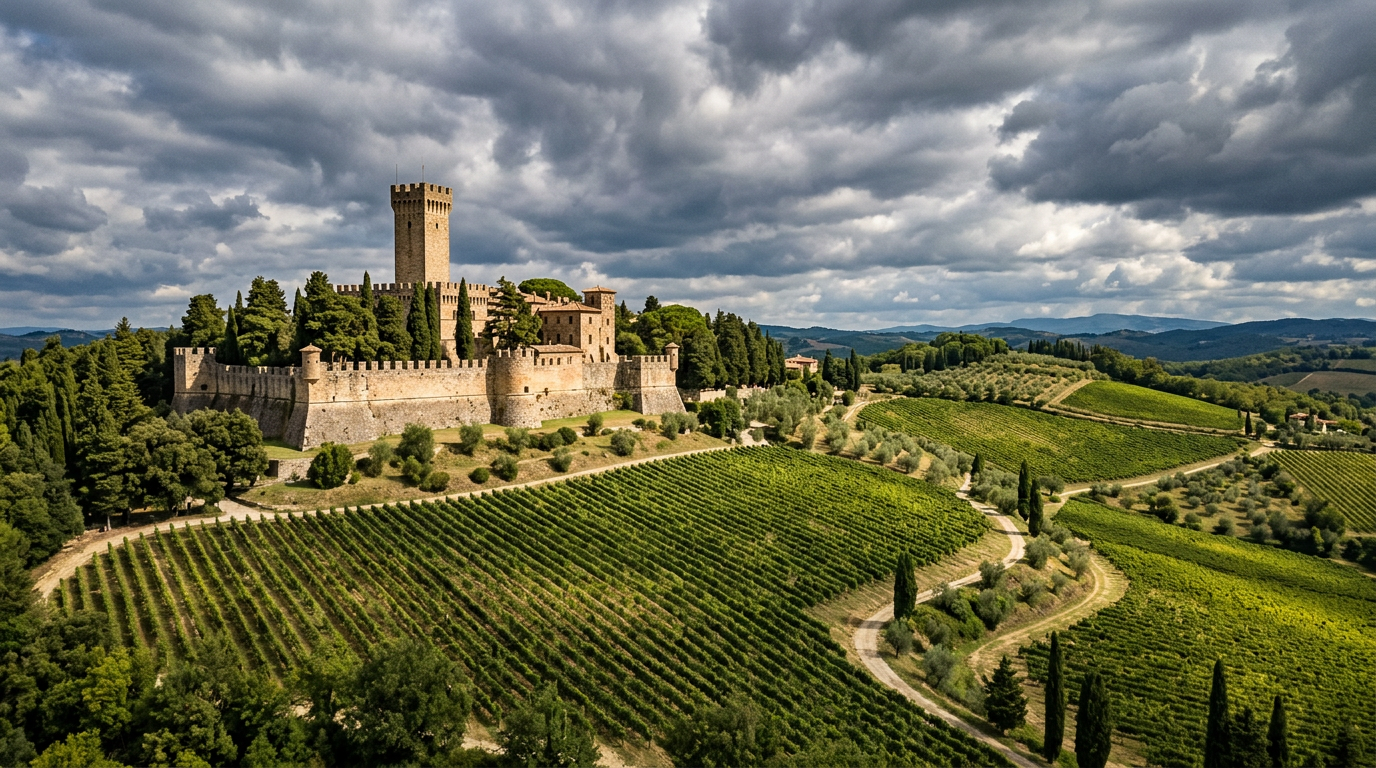
Castello di Brolio is the estate that serious students of Italian wine come to Gaiole specifically to see. It stands on a commanding hilltop about 10 km south of the town, visible from a great distance, its crenellated tower rising above a dense cluster of cypress trees. The castle has been in the possession of the Ricasoli family since the 12th century, one of the longest continuous family ownership records of any estate in Italy.
The historical significance of Brolio rests primarily on one man: Baron Bettino Ricasoli, who lived from 1809 to 1880. He was a politician — twice Prime Minister of Italy in the years following unification — but his enduring contribution was to wine. In the 1870s, working systematically in his own cellar, he developed a formula for Chianti based on the proportions of Sangiovese, Canaiolo, and other local varieties. This formula, though later modified by official regulations, essentially established Chianti as a recognisable and consistent wine style rather than a loose regional category.
Visiting the estate gives you access to the castle gardens and, on guided tours, to the castle interior. The gardens are open from April to October, Monday to Saturday 10:00 to 19:00 and Sunday 11:00 to 18:00. Entrance costs around 5 euros. The guided tours of the castle interior run at set times and provide historical context that makes the architecture meaningful.
The enoteca adjacent to the castle offers wine tastings. A standard tasting of three wines costs around 20 euros per person. The Colledilà Gran Selezione, the estate’s top wine from a single vineyard, is available in the tasting at additional cost. It is one of the benchmark bottles of modern Chianti Classico.
Wineries in the area
The Gaiole territory has several estates beyond Brolio that merit a visit.
Badia a Coltibuono is set in a former Benedictine monastery about 8 km north of Gaiole. The estate has been producing wine since the medieval period. The abbey complex, including the Romanesque church and cloister, is intact. The restaurant in the old refectory is one of the finest in the Chianti — focused on seasonal Tuscan cooking, with a wine list anchored in the estate’s own production. Reserve well ahead. Cellar tours and tastings are available by appointment, starting at around 20 euros.
San Felice is a large, well-organised estate south of Gaiole, notable for its serious research into native Tuscan grape varieties over several decades. The estate runs a small wine museum, a restaurant, and a hotel. Tastings by appointment, around 25 euros per person.
Castello di Ama, roughly 10 km south of Gaiole, has built an international reputation for both its wines and its contemporary art programme. Single-vineyard Chianti Classicos from L’Apparita and San Lorenzo are among the most praised wines in the denomination. The art installations by major international artists, integrated into the estate buildings, make this one of the most distinctive winery visits in Italy. Visits by appointment, around 30 to 40 euros per person.
For a simpler and spontaneous option, the wine bar in Gaiole town centre pours by the glass from local producers and sells bottles to take away.
How to get there from Barberino Val d’Elsa
Gaiole in Chianti is about 40 km from Barberino Val d’Elsa. The drive takes approximately 40 minutes.
The most scenic route heads east from Barberino on the SP1 through San Donato in Poggio and Panzano in Chianti, then south on the SR222 through Greve, and then further south through Radda to Gaiole. This route takes slightly longer but passes through the full breadth of the Chianti Classico landscape.
A faster option goes south on the SR2 to Poggibonsi, then east on the SR429 through Radda toward Gaiole. This shaves about 10 minutes off the journey.
Public transport to Gaiole is minimal and impractical for visiting the estates. A car is essential.
Where to stay
Sogno d’Oro in Barberino Val d’Elsa is well positioned for a Gaiole day trip. The 40-minute drive goes through the heart of the Chianti Classico zone. Arrive early to visit Castello di Brolio in the morning light — the castle looks particularly dramatic from below when the sun is still low. Take lunch at Badia a Coltibuono if you have reserved, or at a simpler trattoria in the area. Return through the Chianti hills in the late afternoon.