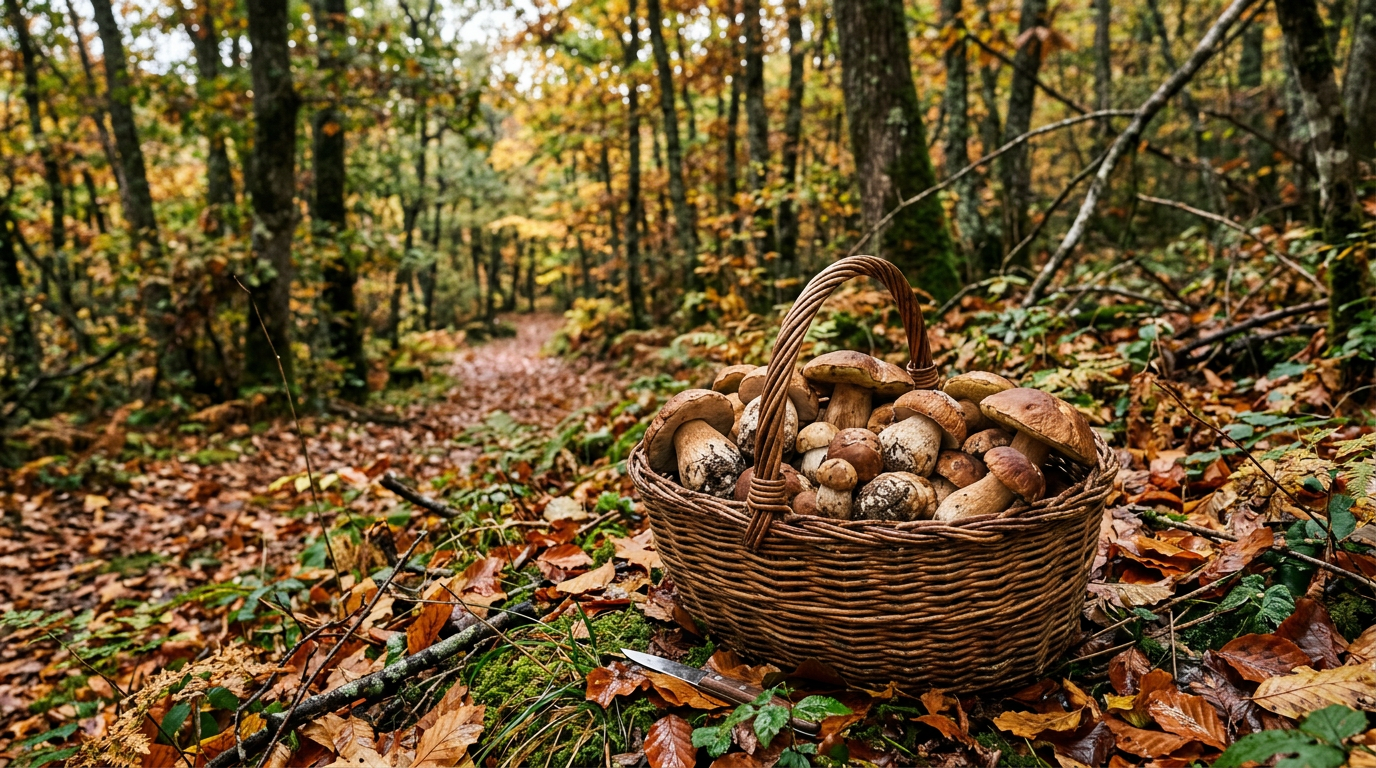
Porcini mushrooms in Tuscany: season, forests, and where to eat them
Every autumn, Tuscany’s forests produce one of the most anticipated ingredients in Italian cooking. The porcino, Boletus edulis, emerges from the soil beneath chestnut and oak trees in the weeks after the first rains of September, and its presence transforms restaurant menus across the region. Local markets fill with wicker baskets. Forest paths see an increase in figures moving quietly among the trees in the early morning hours.
If you are staying in Barberino Val d’Elsa during September or October, you are in a good position to experience porcini season properly: through the forests of the nearby Chianti hills, through local markets and trattorias, and — with the right preparation — through picking them yourself.
Porcini mushrooms in Tuscany
The Boletus edulis is the undisputed king of the Tuscan wild mushroom calendar. It grows in mycorrhizal association with the roots of specific host trees, primarily chestnut, oak, and at higher altitudes, fir and pine. The relationship is symbiotic: the fungus extends the root system’s ability to absorb water and minerals, while the tree provides sugars that the fungus cannot produce on its own. Remove either partner and the mushroom disappears.
The visual profile of a good porcino is unmistakable. The stem is thick, barrel-shaped, and white to pale brown, sometimes with a fine net pattern just below the cap. The cap is rounded and brown, ranging from tan in young specimens to deep chestnut in mature ones. The underside is a dense sponge of tiny pores, white or yellowish-white in fresh specimens, turning greenish-yellow as the mushroom ages. Never eat a Boletus with red pores. The Boletus satanas, which has a red-tinted pore surface, is toxic.
The flavour of fresh porcini is earthy, nutty, and deep in a way that dried mushrooms only approximate. Grilled simply over wood with olive oil, garlic, and parsley, a fresh porcino cap is one of the most direct and satisfying food experiences the Italian forest can produce. Sliced thin over pasta with a little butter or cream, it fills the kitchen with an aroma that is immediately and completely autumnal.
Tuscany also produces smaller but significant quantities of other desirable wild mushrooms. Ovoli, the Amanita caesarea, is a golden-orange, egg-shaped mushroom considered among the most prized in Italian cooking. Finferli, chanterelles, grow in summer and early autumn in beech and oak woodland. Chiodini, honey fungus, appear in clusters at the base of trees in autumn. These appear alongside porcini at market stalls and in restaurant kitchens throughout the season.
When the season is right
The primary porcini season in Tuscany falls between late August and the end of October. Exact timing depends on two variables: rainfall and temperature.
The optimal pattern is a warm and dry August that stresses the soil, followed by significant rain in the final week of August or early September. This combination triggers a first flush in the higher forests, above 700 metres, typically in the first two weeks of September. By mid-September the season extends to lower elevations.
October is consistently the most reliable and productive month for porcini. Night temperatures drop into single digits, soil moisture is higher and more stable, and the mushrooms that emerge tend to be firmer and better quality than the early September specimens. The risk of heat damage, which causes early-harvested mushrooms to soften and decompose rapidly, is lower.
A secondary spring flush sometimes occurs between April and early June, particularly in years with adequate winter rainfall and mild spring temperatures. Spring porcini are found in similar woodland zones but in smaller quantities and with less predictability.
In dry years the season can fail entirely. When August and September receive very little rain, the mycelium does not flush and the mushrooms do not appear. This is a real risk in the increasingly dry Tuscan autumns of recent years. The best real-time intelligence on what the season is producing comes from local market sellers, foragers, and restaurant owners who are tracking conditions actively.
Forests near Barberino Val d’Elsa
The most productive porcini forests in immediate reach of Barberino Val d’Elsa are in the Chianti hills to the east and northeast.
The chestnut and oak woodland above Panzano in Chianti, about 15 kilometres from Barberino, is well-known locally for autumn mushrooms. The elevation here runs from 400 to 600 metres, which is on the lower end of the ideal range but productive in good years. The forests above Radda in Chianti, about 30 kilometres from Barberino, are at higher elevation and tend to be more consistently productive.
For genuinely serious mushroom picking, the Casentino nature reserve northeast of Arezzo, about 80 kilometres from Barberino, is one of the most productive woodland areas in central Italy. The fir, beech, and mixed hardwood forest here covers tens of thousands of hectares at elevations between 500 and 1,600 metres. The volume of mushrooms in a good autumn in the Casentino is extraordinary. The drive is longer but the payoff is proportional.
Closer to Barberino, the mixed woodland between Colle di Val d’Elsa and Certaldo can produce porcini in good years, particularly in the areas of denser oak and chestnut. These forests are less celebrated than the high Chianti or the Casentino, which means they see fewer pickers and can produce well in years when conditions are right. Local knowledge is essential for finding the productive zones.
Restaurants with mushroom dishes
During porcini season, trattorias and ristoranti throughout the Val d’Elsa and Chianti update their menus almost weekly to reflect what the forest is producing. Some kitchens effectively become mushroom restaurants in October, with the ingredient appearing in multiple courses.
The most common and honest preparation is porcini trifolati: sliced porcini sautéed in olive oil with garlic and fresh parsley. This appears as an antipasto, a side dish, or a topping for bruschetta. When the mushrooms are very fresh, this simple preparation is completely satisfying.
Tagliatelle al porcino is the pasta preparation you will see most often. Wide egg pasta, a sauce of fresh porcini, and the decision of whether to add a little cream or butter depends on the cook and the region. In Tuscany the approach tends toward olive oil rather than cream. The porcino is present enough to not need enrichment.
Porcini grillati is the most direct presentation: a whole cap, sometimes large enough to fill a plate, grilled over wood coals and dressed with olive oil, salt, and a squeeze of lemon. This requires very fresh mushrooms and a confident hand with the heat.
Some restaurants in October offer a dedicated mushroom tasting menu, running through five or six courses in which porcini appears in different preparations. These require advance booking. Ask about availability when you call to reserve.
The most important question to ask when ordering mushroom dishes is whether the porcini are fresh and local, funghi freschi di stagione. Many restaurants use dried or frozen porcini year-round. These are valid ingredients but not what you are in Tuscany in October to eat. A good kitchen that is using fresh local mushrooms will be proud to say so.
Trattorias in Barberino Val d’Elsa, Certaldo, and San Donato in Poggio all have options during mushroom season. Ask at Sogno d’Oro for a specific recommendation based on what is currently on the menu.
How to pick mushrooms safely
Picking wild mushrooms in Tuscany requires a permit, called a tesserino, issued by the local municipality or the regional forestry authority. For non-residents the cost is typically five to fifteen euros per day. The permit limits the daily collection quantity, usually three kilograms per person, and defines the zones where picking is authorised. Forestry guards patrol popular areas during the season and fine pickers without permits.
Safe identification is the most important rule. Tuscany has toxic Boletus species that are superficially similar to the edible porcino. The most dangerous is the Boletus satanas, which has a red or orange-red pore surface, a reddish base to the stem, and turns blue immediately when cut. Never eat a Boletus that turns blue when cut, and never eat one with red pores. The edible porcino has white to yellowish-white pores and flesh that turns slightly blue or not at all.
Take a photographic field guide or use a verified identification app such as iNaturalist or Picture Mushroom. These tools are useful but not infallible. If any doubt exists, do not eat.
Many Tuscan municipalities offer free mushroom identification services during the season. Bring your collected basket to a local pharmacy or the ASL (Azienda Sanitaria Locale) office. Trained inspectors will check each specimen and remove any that are unsafe. This service is free, takes fifteen minutes, and can save your life. Use it if you are not completely certain of your identification.
Go with an experienced local picker for your first time. The speed at which an experienced trifolao moves through a forest, reading the ground for signs of mushroom activity, and the confidence with which identifications are made, is instructive in a way that no guide can replicate.
Where to stay
Sogno d’Oro in Barberino Val d’Elsa sits at the edge of the Chianti mushroom country, with the productive oak and chestnut forests of Panzano and Radda within easy reach and the trattorias of the Val d’Elsa ready to serve fresh porcini from October onward.
Autumn in this landscape is a season in its own right, worth planning a trip around: the light is extraordinary, the wine harvest fills the farms with activity, the mushrooms and truffles are in the ground and on the menu, and the summer crowds are entirely gone.