Chianti events 2026: open cellars, Expo, harvest festivals, and how to plan
The Chianti Classico denomination organises its annual calendar around a clear sequence of events that follow the agricultural year. From the spring previews of new vintages through to the October harvest celebrations and the quieter winter tastings, there is always something happening within reach of Barberino Val d’Elsa.
Knowing which events are worth planning your visit around, and how to access current information, makes the difference between discovering a memorable cellar experience by chance and deliberately attending the best of what the zone offers.
Chianti events in 2026
The Chianti Classico wine zone covers the territory between Florence and Siena, with Greve in Chianti as its central town and market. Barberino Val d’Elsa sits on the western edge of the zone, in the foothills toward the Val d’Elsa. This position gives you access to the events at Greve and across the denomination without being in the middle of the tourist flow on the Chiantigiana.
Events in the Chianti operate at different scales and with different degrees of openness. The large denomination events — the Expo, the Anteprima, the Cantine Aperte — are public and require simple advance registration or ticket purchase. Open cellar days at individual estates often require booking directly with the producer. Village festivals are open without booking, typically requiring only a short drive and the ability to find a parking space.
The character of the wine tourism experience also varies significantly by season. Summer events are busy, often running in parallel with general tourism, which means wine tasting happens alongside general sightseeing and restaurant dining. Autumn events are more focused: the visitors are there for the wine, the harvest is visible in the vineyards, and the atmosphere at estate events is more intimate.
Chianti Classico Expo
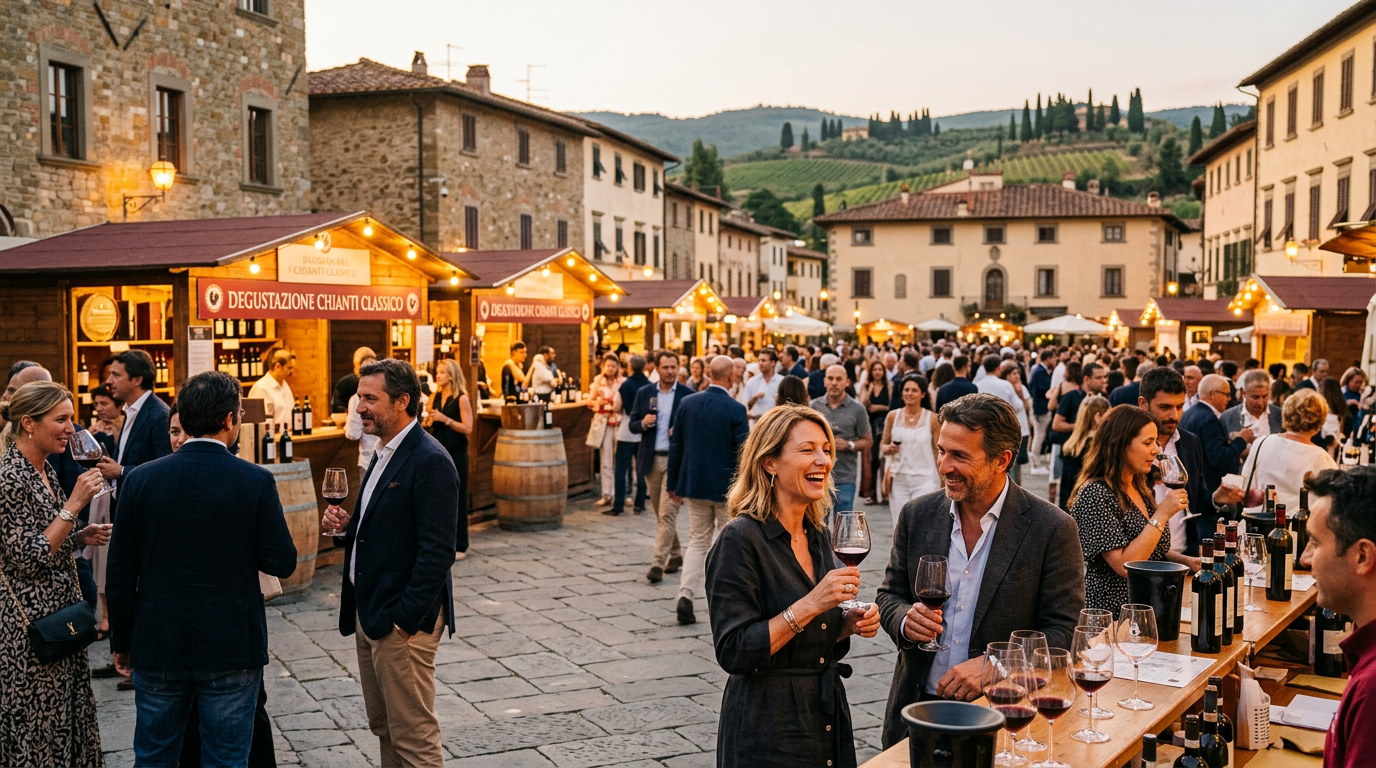
The Chianti Classico Expo, also referred to as the Chianti Classico Wine Festival, is the flagship public event of the denomination. It takes place in Greve in Chianti, approximately 20 kilometres from Barberino, in the triangular Piazza Giacomo Matteotti that forms the heart of the town. The event typically occupies a long weekend in September, usually in the second or third week of the month.
More than 100 producers set up tasting stands under the loggias that ring the piazza. Visitors buy a tasting glass at the entrance — which includes an initial tasting credit — and move freely between producers, sampling current vintages and sometimes older releases. The format is uncurated: you can spend as long as you want at any stand, ask questions directly of winemakers who are often present in person, and compare styles across the full spectrum of the denomination.
A tasting ticket has cost approximately 25 to 35 euros in recent years, with additional credits purchased as needed. Greve is 25 minutes from Barberino by car on the Chiantigiana, the SS222. The road passes through some of the most characteristic Chianti landscape in the zone, particularly the section north of Greve toward the valley of Panzano.
Arrive early, ideally when the event opens in the morning. The piazza fills significantly by midday and the combination of summer heat and wine makes mid-afternoon less comfortable than the morning session. Food stalls provide lunch options in the square.
Special winery openings
Cantine Aperte — Open Cellar Day — is organised by the Movimento Turismo del Vino, a national association that promotes wine tourism across Italy. The main event falls on the last Sunday of May. A smaller autumn edition runs in October. Dozens of Chianti Classico producers participate, opening their cellars and estates to visitors for guided tours, tastings, and in some cases special experiences such as vertical tastings of older vintages or access to parts of the winery not normally shown.
Participating estates range from large established producers with professional visitor centres to small family estates that open only on this day each year. The website of the Movimento Turismo del Vino publishes the participating estates each year. Booking with individual producers in advance is advisable for estates with limited capacity and for any special tastings or events within the open day.
The Chianti Classico Consortium also organises its own preview events, including the Anteprima Chianti Classico in spring, where new releases of Chianti Classico, Riserva, and Gran Selezione are presented to press, trade, and registered visitors. This is a more focused and technical event than the Expo but offers early access to the most recent vintages before they are widely distributed.
Individual estates around Barberino Val d’Elsa organise their own private events throughout the year: harvest dinners in September when the grapes come in, pruning days in late winter, bottling celebrations in spring. These are typically communicated through producer newsletters and social media. Following the estates you are most interested in is the reliable way to know about them.
Village festivals
The Chianti villages have a parallel event tradition that is distinct from the wine denomination calendar but deeply connected to the wine culture of the area. These village festivals draw more heavily on local history, food, and community identity than on wine as a commercial product, even though wine is always present.
San Donato in Poggio, eight kilometres from Barberino, is one of the most complete surviving medieval villages in the Chianti. Its autumn festival, usually in late September, celebrates the grape harvest with communal meals, wine from local estates, and activities that fill the small walled village for an evening or a weekend. This is a quieter and more local event than the Expo at Greve, which makes it more accessible in atmosphere if not always in scale.
Panzano in Chianti, 25 kilometres from Barberino on the Chiantigiana, has developed its own distinct food identity centred on butcher and restaurateur Dario Cecchini, whose shop on the main street has been the subject of international media coverage for two decades. Panzano’s summer and autumn events, including the Officina della Bistecca dinners and various community celebrations, attract visitors from across Europe and have a particular intensity of food culture that is unusual even for Chianti.
Radda in Chianti and Castellina in Chianti, 35 to 40 kilometres from Barberino, hold their own summer events. The Castellina event, staged within the walls of the medieval fortress, is particularly atmospheric when the weather is warm.
How to stay updated on the calendar
The Chianti Classico Consortium publishes its event calendar on its official website. This is the authoritative source for denomination-level events including the Expo, the Anteprima, and any official tastings. Check it in January to identify the major fixed dates and in March to confirm specific timing.
The Strada del Vino Chianti Classico website lists member estates and their visitor information, including booking details for tastings and tours. Individual producers’ websites and social media channels are the best sources for estate-level events that are not part of the denomination calendar.
For village-level festivals and sagre, the Pro Loco websites of individual comuni — Greve, Radda, Gaiole, Castellina, San Donato in Poggio, and others — publish their own local calendars. These are more reliable than regional aggregator sites, which are often not updated in real time.
The combination of the denomination website for major events and direct contact with individual producers for smaller ones covers the great majority of what is worth attending. For the very local, informal end of the calendar — the village sagra, the estate dinner with no online presence — asking your host remains the most effective method.
If you are staying at Sogno d’Oro during a period that corresponds to a particular event, mention it when you book. The hosts follow the local calendar and can provide information and sometimes practical help with booking or directions that is not available elsewhere.
Where to stay
Sogno d’Oro guesthouse in Barberino Val d’Elsa is positioned on the western edge of the Chianti Classico zone with good access to both the major events at Greve and the smaller village festivals of the surrounding area. The distance to Greve is 25 minutes by car. The distance to San Donato in Poggio, the nearest village with a significant local festival tradition, is about eight kilometres.
After a day of tastings and a village festival, returning to a quiet property in the countryside restores the equilibrium that sustained wine tasting in warm weather sometimes disrupts.