Things to do in Val d'Elsa: villages, wine, and nature
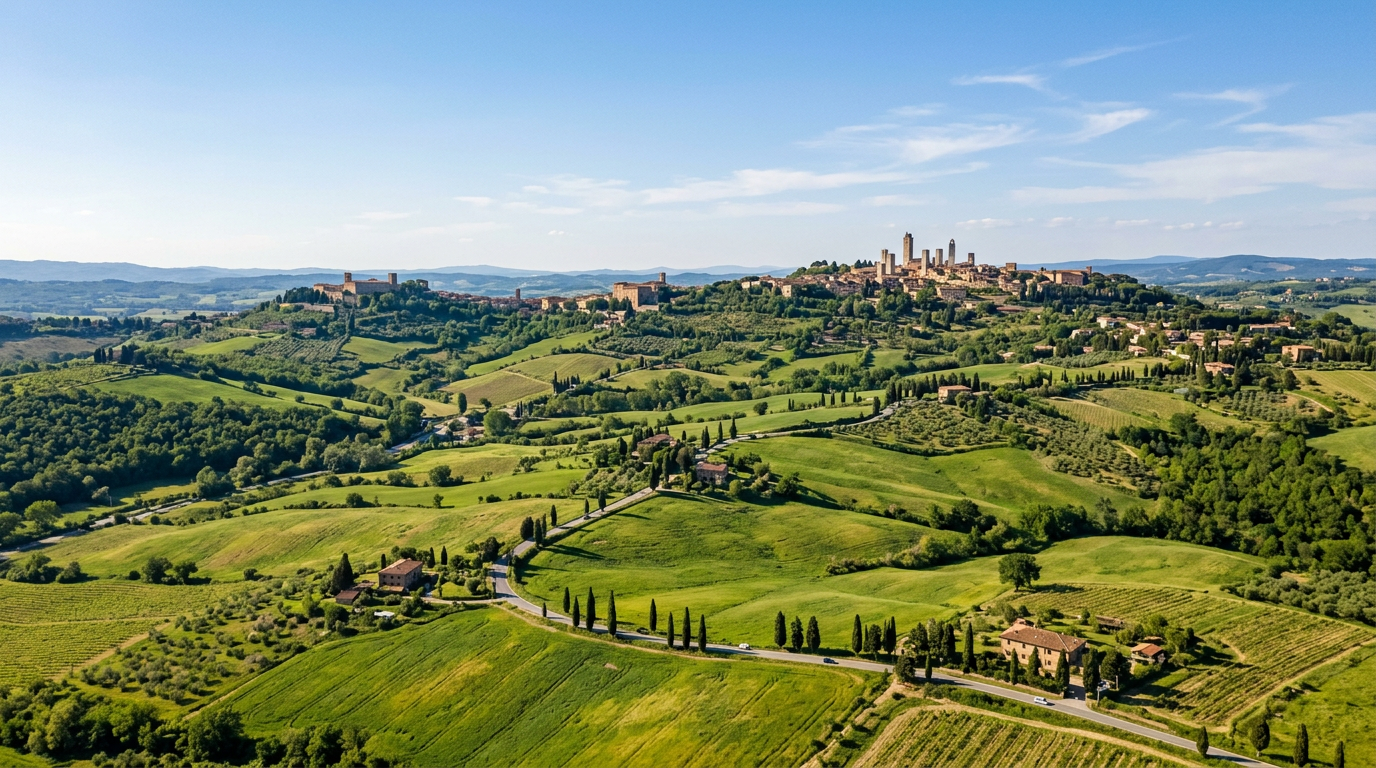
The Val d’Elsa follows the Elsa river south from the outskirts of Florence toward Colle Val d’Elsa and the hills above Siena. It is not one of the marketed Tuscan valleys — not the Val d’Orcia with its photogenic cypresses and magazine cover landscapes, not the Chianti with its internationally recognised wine brand. The Val d’Elsa is more ordinary in the best sense of the word: medieval hilltowns with real populations, working farms still producing wine and oil, and a pace of life that has not been reorganised for tourism.
That is precisely what makes it a rewarding place to spend a week. The major Tuscan cities and sights are within easy reach. But the daily texture of where you are staying — the market in the square, the road through the olive groves, the view from the village walls — belongs to Tuscany rather than to the tourist version of it.
Val d’Elsa: what to do
The activities available in the Val d’Elsa cover a broad range. History and art are concentrated in a series of towns and villages, each with something distinct to offer. Wine and food are woven into the landscape in the form of Chianti Classico estates to the east and local producers throughout the valley. Nature is accessible through a network of marked trails, cycling routes, and the river path itself.
The towns that anchor the valley are Certaldo to the north-west, Barberino Val d’Elsa and San Donato in Poggio in the central section, and Colle Val d’Elsa to the south. Each occupies a ridge above the valley floor and each looks very different from the others. Certaldo is brick; San Donato is stone; Colle Val d’Elsa combines a modern lower town with a long narrow medieval upper ridge. Exploring each one requires only a morning or afternoon, so the valley rewards a flexible rather than a packed itinerary.
The eastern boundary of the Val d’Elsa is also the western boundary of the Chianti Classico zone. Wine estates are within 20 minutes of the valley floor. Several of the most interesting producers in the DOCG are effectively your neighbours if you are staying near Barberino.
A practical approach for a week: use three days for the local villages, one day for Siena (40 km south), one day for San Gimignano (30 km west), one day for a winery tour in the Chianti hills, and one day for the coast or Montalcino if you want a longer excursion.
The territory between Florence and Siena
The Val d’Elsa occupies a genuinely strategic position in central Tuscany. Florence is 35 to 40 km from Barberino Val d’Elsa — around 35 to 45 minutes by car depending on traffic and the route. Siena is 40 km south, about 35 minutes on the SR2. San Gimignano is 30 km west, 30 minutes by car on good days.
These are not everyday commuting distances, but they are very comfortable for day trips. You can visit Florence for a museum morning, return for lunch, and still have an afternoon in the local countryside. The logistics of Tuscany tourism work well from this base.
To the east, the SR222 (the Via Chiantigiana) climbs into the Chianti hills and connects Barberino to Panzano, Greve, Radda, and Castellina in Chianti — all within 30 to 40 minutes. To the south, the SR2 (Via Cassia) follows the old Roman road through Colle Val d’Elsa toward Siena. The Val d’Orcia begins around 60 to 70 km south of Barberino.
The road network in the area consists primarily of provincial roads (SP) and the two main state roads (SR2 and SR222). Driving is relatively relaxed. The SP roads that cut through the agricultural land between villages are particularly good for cycling — low traffic, varied terrain, and countryside views that reward a slower pace.
Villages to visit
Barberino Val d’Elsa occupies a narrow ridge above the valley and has kept its medieval walls, gates, and civic buildings almost entirely intact. The Palazzo Pretorio on the main street bears carved stone coats of arms from the families who governed here during Florentine rule. The view from the walls over the surrounding vineyards is one of the most quietly satisfying in the valley.
Certaldo, 12 km to the north-west, is the birthplace of Giovanni Boccaccio, author of the Decameron. The upper medieval village of Certaldo Alto, reached by funicular from the lower modern town, is built in warm red brick rather than stone and has an unusually atmospheric quality. The house museum dedicated to Boccaccio and his tomb in the church of Santi Jacopo e Filippo are both worth visiting.
Colle Val d’Elsa, 18 km south, is the largest town in the valley with about 22,000 inhabitants. Its medieval upper district, Colle Alta, is a narrow ridge of Gothic and Renaissance architecture that includes the birthplace of Arnolfo di Cambio — architect of Florence’s Cathedral, Palazzo Vecchio, and Santa Croce. The Crystal Museum in Colle is the only one of its kind in Italy and covers the town’s centuries-old crystal glass-making tradition.
San Donato in Poggio, between Barberino and Tavarnelle Val di Pesa, is a tiny medieval hamlet that has barely changed in five hundred years. The stone walls, the small Romanesque church at the gate, and the enoteca in the main square make it worth a 30-minute stop on any drive through the area.
Castelfiorentino, about 18 km north-west, holds an important collection of detached fresco cycles by Benozzo Gozzoli, the 15th-century painter known for his vivid, narrative style. The museum dedicated to these works is small but excellent.
Activities in nature
The Val d’Elsa is well suited to cycling. The roads are hilly but accessible, and the terrain rewards effort with views rather than punishing climbers with prolonged steep gradients. Most of the valley can be explored on a hybrid or gravel bike. Electric bikes are increasingly available from rental shops in the larger towns and from some agriturismi — a practical option for routes that include longer climbs.
Marked walking trails connect most of the significant villages. The Cammino di Dante passes through this territory, following a waymarked route associated with Dante Alighieri’s travels in the region. It passes through vineyards, oak woods, and agricultural land, connecting Certaldo to the south with Florence to the north. The Via Francigena also runs through the valley — the section between Barberino Val d’Elsa and Colle Val d’Elsa is well waymarked and passes through characteristic Val d’Elsa landscape on a mix of asphalt and unpaved farm tracks.
The Elsa river itself runs along the valley floor and has accessible paths along several stretches. The water is clear and relatively clean, with shallow swimming spots particularly visible near Colle Val d’Elsa. Bird watching in the agricultural land and river margins is good in spring: hoopoes, shrikes, cuckoos, and various warblers are regular visitors. Herons and kingfishers are year-round residents of the river.
Why choose Val d’Elsa for your holiday
The Val d’Elsa does not attract the same numbers as the Val d’Orcia or the Cinque Terre. Visitor facilities exist, but the area has not been rebuilt around them. The restaurants are mostly serving the people who live here, the markets sell local produce rather than Tuscan souvenirs, and the landscape — vineyards, wheat fields, olive groves, woodland — is functional farmland as much as it is scenic backdrop.
Accommodation costs here tend to be lower than in the most intensively visited parts of Tuscany. You get similar countryside, similar food, and similar wine access to central Chianti, but without the premium attached to a famous address.
The food culture is solidly regional. Tuscan dishes made with local ingredients dominate every menu: pappardelle with wild boar ragù, ribollita, pici all’aglione, bistecca alla Fiorentina from Chianina cattle. Local pecorino is sold at markets and in village shops. Olive oil from the surrounding groves is sold direct from producers in season.
Wine tourism in the Val d’Elsa is relaxed and largely informal. Several Chianti Classico estates within easy reach of Barberino welcome visitors without strict booking requirements, particularly outside July and August. You can stop at a cantina on a back road, taste a few wines, and buy a case to take home. That kind of spontaneous encounter with local producers is part of what makes this territory genuinely satisfying.
Where to stay
Sogno d’Oro is set near Barberino Val d’Elsa, in the heart of the Val d’Elsa. The guesthouse occupies a position in the typical Tuscan landscape of this valley — vineyard views, olive groves, and the quiet of open countryside.
Everything this guide describes is within practical reach: close enough for a morning visit and return, far enough to feel like a real excursion. Whether you come for the art, the wine, the walking, or simply the experience of being somewhere that functions at its own pace, the Val d’Elsa delivers.